
Overnight Swaps and Broker Execution Types
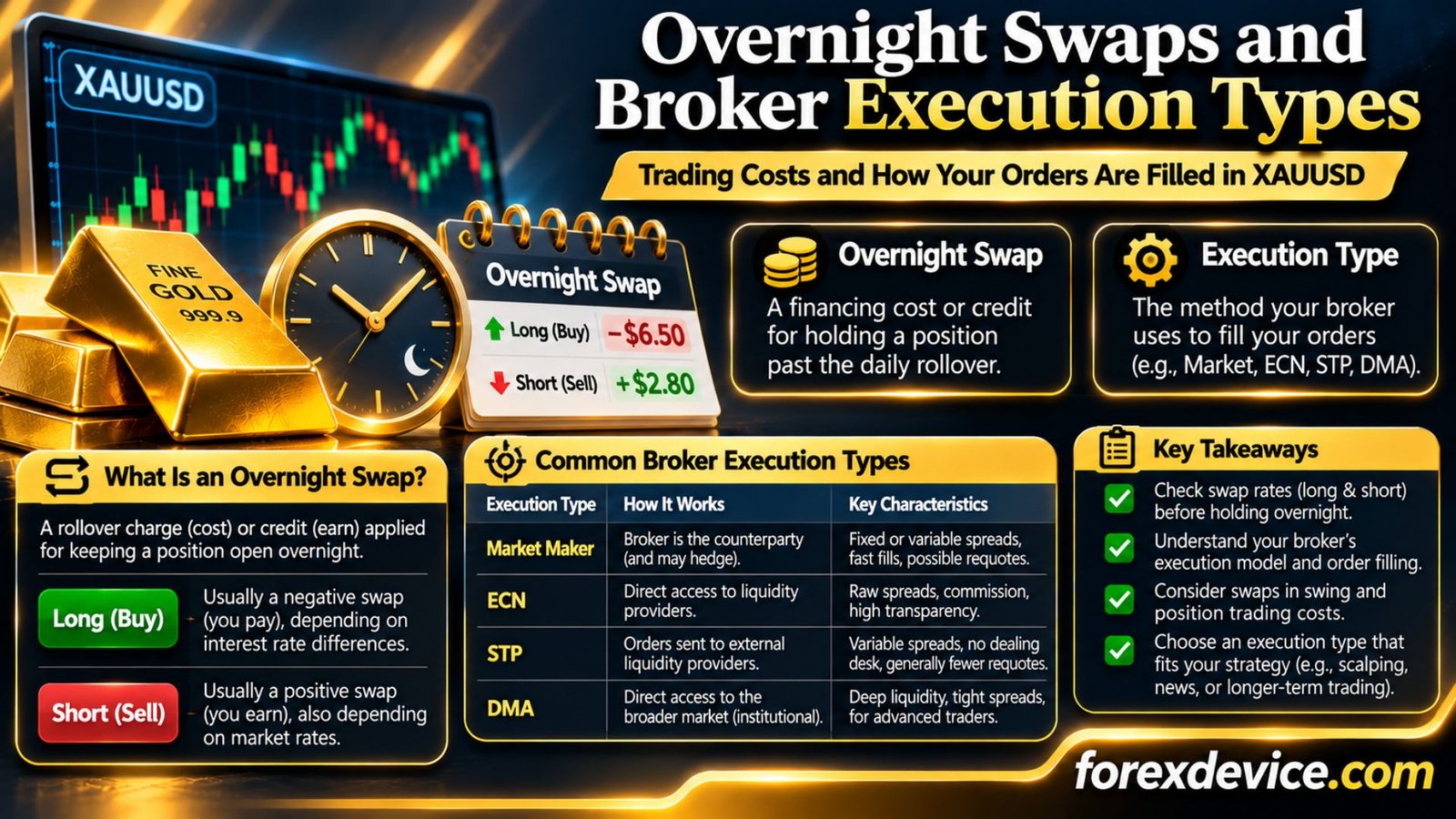
Overnight Swaps and Broker Execution Types
A gold trade can move in the expected direction and still produce a disappointing net result. The reason is that price movement is only one component of trading performance. Financing charges, commissions, spreads, execution quality, and the way orders are routed can all influence what a trader actually earns or loses.
For XAUUSD traders, two areas deserve particular attention: overnight swap charges and broker execution arrangements. Swaps can accumulate when leveraged gold positions remain open across a broker’s daily rollover. Execution arrangements determine how orders are priced, processed, filled, rejected, or affected by slippage.
Understanding these mechanisms helps traders compare brokers more intelligently, investigate unexpected trading costs, and design strategies that account for the realities of live execution.
The central principle: A trading strategy should be evaluated using its net executable results—not simply the movement of the gold price or the advertised spread of a broker.
What Is an Overnight Swap in XAUUSD Trading?
An overnight swap, often called rollover financing, is a charge or credit associated with maintaining certain leveraged trading positions beyond a broker’s designated daily rollover time.
In retail XAUUSD CFD trading, a trader typically obtains exposure to changes in the gold price without taking physical delivery of the metal. The broker’s product structure may involve financing adjustments because the position represents leveraged market exposure.
Depending on the instrument and broker, the overnight adjustment may be negative or positive. Many gold CFD arrangements charge financing for holding long positions, while short-position financing depends on the applicable rates and contract terms.
A swap should not be confused with the bid-ask spread. The spread is associated with the difference between executable buying and selling quotations, whereas swap financing is associated with carrying an eligible position across rollover.
Why swaps matter to different trading styles
A trader who opens and closes a position before rollover may avoid overnight financing on that position. A swing trader holding gold for several days may accumulate multiple adjustments.
For short-term strategies with relatively small expected profits, even modest recurring financing costs can influence overall profitability.
For longer-duration positions, the cumulative impact can become more significant, especially when the position size is large or the applicable financing rate changes.
Intraday Trading
Positions closed before the broker’s rollover generally avoid overnight swap charges, although spreads and commissions still apply.
Multi-Day Trading
Positions held across rollover may incur repeated financing adjustments, including multi-day rollover charges under the broker’s schedule.
The exact treatment depends on the symbol, trading account, rollover schedule, and broker contract terms.
How Are XAUUSD Overnight Swap Charges Calculated?
There is no single universal swap formula that applies to every gold CFD broker. Different providers use different financing models and symbol calculation methods.
Some platforms specify swaps in points, while others express them in account currency, instrument currency, or as an annualized percentage.
The broker’s symbol specification should be treated as the authoritative source for the calculation method.
Example: Swap expressed in points
Suppose a hypothetical XAUUSD contract has the following specifications:
Worked Example — Overnight Financing
- Contract size: 100 ounces per lot
- Position volume: 0.10 lots
- Swap rate: −30 platform points per lot per rollover
- Point size: $0.01 per ounce
- Account currency: USD
Under this simplified points-based calculation, the price-equivalent adjustment is:
30 × $0.01 = $0.30 per ounce.
The position represents 10 ounces, so the financing charge is:
$0.30 × 10 = $3.00.
The example assumes the broker uses the stated points-based method without additional conversion or adjustments. Actual broker swap calculations may differ.
Simplified Points-Based Swap Formula
Swap = Swap points × Point value per lot × Lots × Rollover multiplier
This formula applies only where the broker defines swap in compatible points-based units. Check the symbol’s actual swap calculation mode.
What happens when swap rates change?
Swap rates may change over time as financing conditions, benchmark rates, liquidity costs, or broker pricing arrangements change.
Therefore, a swap value observed today should not automatically be assumed to remain unchanged throughout a multi-week position.
When evaluating longer-duration strategies, traders should use realistic financing assumptions and account for possible changes in rates.
Rollover Timing and Triple-Swap Days
Most retail traders know that markets close for the weekend, but the financing schedule does not necessarily charge one identical swap for every calendar day.
Many brokers apply a multi-day rollover adjustment on a designated weekday to account for non-trading days. This is commonly called triple swap.
However, the exact day and multiplier can differ between XAUUSD CFDs, currency pairs, futures-related products, and broker-specific symbols.
Regular Rollover
A position crosses the broker’s designated daily cutoff and receives the applicable financing adjustment.
Multi-Day Rollover
A designated session may apply a larger adjustment to account for additional calendar days.
Weekend Reopening
Trading resumes after the market break, potentially with changed quotations, spreads, or liquidity.
Is triple swap always charged on Wednesday?
No. Wednesday is commonly associated with triple rollover in spot forex, but gold CFD schedules can differ. Some brokers apply the larger adjustment on Friday or another designated day.
Always inspect the actual XAUUSD symbol specification rather than applying a forex rollover assumption automatically.
Why broker server time matters
Rollover is generally determined by the broker’s configured trading schedule or financing cutoff, not simply by midnight in the trader’s local time zone.
A trader in India may therefore experience the adjustment at a different local clock time from a trader in London or New York.
Daylight saving changes and broker server-time settings can also affect the local-time interpretation of the cutoff.
Before holding gold overnight: Check the broker’s rollover time, the applicable swap rates, the multi-day rollover schedule, and any holiday-related adjustments. These details can change and should not be inferred from the chart alone.
Why Long and Short Gold Positions Can Have Different Swap Rates
Buying and selling XAUUSD do not necessarily create equal financing costs.
The broker may publish separate long-swap and short-swap values because the financing economics of maintaining each direction differ.
For example, an illustrative broker might publish a negative long swap and a smaller negative short swap. Another broker may have a different relationship between the two values.
| Position | Illustrative Daily Swap | Five Standard Rollovers |
|---|---|---|
| Long XAUUSD | −$3.00 | −$15.00 |
| Short XAUUSD | −$1.20 | −$6.00 |
These are hypothetical charges for an identical position size, assuming five single-day-equivalent adjustments, unchanged rates, and no extra holiday multiplier. They are not live broker quotations.
The important lesson is that direction can affect financing costs independently of whether the gold price moves favorably.
Traders holding positions for several days should consider both the expected market movement and the cumulative cost of carrying the trade.
Are Swap-Free Gold Trading Accounts Really Free?
Some brokers offer swap-free accounts or account structures where conventional overnight swap adjustments are not applied in the usual way.
However, swap-free does not necessarily mean that holding a position has no cost.
Depending on the broker, alternative administration charges, holding fees, wider spreads, eligibility requirements, or limits on how long positions can remain open may apply.
Some swap-free arrangements also differ by instrument, account type, or jurisdiction.
What to verify before choosing a swap-free account
- Whether XAUUSD is eligible for swap-free treatment.
- Whether administration or holding fees apply after a specified period.
- Whether spreads and commissions differ from standard accounts.
- Whether restrictions apply to particular strategies or holding periods.
- Whether the broker can change eligibility or account conditions.
For a strategy that holds gold overnight regularly, comparing the full expected holding cost is more useful than focusing on the absence of a conventional swap entry.
Understanding Broker Execution Types: Market Maker, STP, ECN, and Agency Models
Broker execution arrangements describe how trading orders are handled, how prices are sourced, and whether the broker acts as a counterparty, agent, or another type of intermediary.
Terms such as market maker, STP, ECN, and NDD are widely used in retail trading discussions, but their commercial meanings are not always standardized across providers.
For this reason, a broker’s marketing label should not be treated as conclusive evidence of how every order is executed.
Market maker or dealing-desk arrangements
Under a market-making arrangement, a broker or liquidity provider may quote executable bid and ask prices and act as principal to the trade.
The provider may manage its exposure internally or hedge some or all of it with external counterparties.
Market making is a normal function in financial markets. Its presence does not automatically imply poor execution, although the broker’s incentives, pricing transparency, and conflict-management practices deserve consideration.
STP: Straight-Through Processing
STP generally describes electronic order-processing arrangements in which orders are passed through systems or routed toward liquidity sources with limited manual intervention.
However, STP is not a universally standardized legal execution category. Different brokers may use the term to describe different operational structures.
It should not be assumed that every STP-labeled order reaches an independent external venue or that the broker never acts as counterparty.
ECN: Electronic Communication Network
An ECN is an electronic system that can match orders from multiple participants according to its operating rules.
Some retail brokers describe accounts as ECN-style because they provide pricing associated with aggregated liquidity or a commission-based structure.
That label alone does not establish that a retail XAUUSD CFD order is directly matched on a particular independent ECN.
Agency versus principal execution
One useful distinction is whether the broker acts as an agent arranging execution or as principal taking the other side of a transaction.
The precise relationship should be established from the broker’s order execution policy, client agreement, and applicable regulatory disclosures.
| Term | General Meaning | What to Verify |
|---|---|---|
| Market Maker | Quotes prices and may act as principal | Pricing, hedging, execution and conflicts |
| STP | Electronic order routing or processing | Actual routing and counterparty arrangements |
| ECN | Electronic network matching participant orders | Whether orders access a genuine network |
| NDD | Marketing term for no dealing desk | Execution policy and actual broker role |
| Agency | Broker arranges execution for the client | Venue, fees and routing arrangements |
Execution quality should ultimately be evaluated using observable outcomes, contractual disclosures, and appropriate regulatory information—not labels alone.
Market Execution Versus Instant Execution in MetaTrader
MetaTrader platforms support different execution modes, and the available mode is determined by the broker and symbol configuration.
Two commonly discussed arrangements are market execution and instant execution.
Market execution
Under market execution, an order is submitted for execution at an available market price under the broker’s execution conditions.
The final fill may differ from the quotation observed when the order was submitted, particularly during rapid market movement or when liquidity is limited.
Market execution does not guarantee a specific price or eliminate the possibility of slippage, rejection, or partial filling where applicable.
Instant execution
Under instant execution, the requested price is relevant to the execution process, subject to permitted deviation and the broker’s rules.
If the requested conditions cannot be met, the platform may return a requote or reject the request rather than filling at a materially different price.
The precise behavior depends on the trading platform, order parameters, and broker configuration.
| Characteristic | Market Execution | Instant Execution |
|---|---|---|
| Requested price | Execution based on available market conditions | Requested price and permitted deviation matter |
| Slippage | Possible | Possible within applicable execution rules |
| Requotes | Generally not the defining mechanism | May occur when the requested price is unavailable |
| Execution certainty | Not guaranteed | Not guaranteed |
Neither execution mode is automatically superior for every strategy. A trader must consider actual fill quality, execution reliability, price deviation, and the market conditions in which orders are placed.
Slippage, Requotes, Rejections, and Partial Fills
Execution costs are not limited to the advertised spread. The price requested by a trader can differ from the price ultimately received.
Slippage
Slippage is the difference between the expected or requested execution price and the actual fill price.
Slippage can be unfavorable or favorable, depending on market conditions and the execution arrangement.
Example: Unfavorable Slippage on a Gold Buy
A trader expects to buy XAUUSD at $4,000.50, but the actual fill occurs at $4,001.20.
The unfavorable price difference is $0.70 per ounce.
If the position represents 10 ounces, the additional entry cost relative to the expected price is:
$0.70 × 10 = $7.00.
This cost is separate from any commission and should be distinguished from the bid-ask spread already reflected in the expected and executed quotations.
Requotes
A requote occurs when the original requested execution price is no longer available under an execution arrangement that supports requoting.
The trader may be offered another price or need to submit a new order.
Order rejections
Orders may be rejected because of insufficient margin, invalid volume, market closure, unavailable prices, trading restrictions, or other execution conditions.
A rejected order is not necessarily evidence of broker misconduct. The platform journal and broker’s execution policy can help establish the reason.
Partial fills
Some execution arrangements permit only part of the requested volume to be filled when sufficient liquidity is unavailable for the full amount.
Whether partial fills are supported depends on the platform, order filling policy, broker, and instrument.
For a more detailed explanation of bid and ask pricing, read Understanding Bids, Asks, and Spreads.
Calculating the Real Cost of an XAUUSD Trade
To compare trading arrangements accurately, traders need to account for every relevant cost rather than examining spreads in isolation.
Common cost components include the bid-ask spread, commissions, overnight financing, and unfavorable slippage.
Practical Net Trading Result
Net P/L = Gross P/L from Actual Fills − Separate Fees + Financing Credits
Gross P/L calculated from actual executed bid and ask prices already incorporates the spread and any execution slippage reflected in those fills.
A complete multi-day trade example
Worked Example — Gold Position Held Overnight
Assume a trader opens a 0.10-lot XAUUSD buy position, representing 10 ounces under a 100-ounce contract specification.
- Executed entry ask: $4,000.50
- Executed closing bid: $4,012.50
- Price difference: $12 per ounce
- Gross profit: $120
- Round-trip commission: $7
- Total overnight financing: −$9
Because the entry and exit prices are actual executed quotations, the spread and any slippage embedded in those fills are already included.
Net result = $120 − $7 − $9.
The example shows how a profitable market movement can produce a smaller net result after financing and execution-related costs.
Why cost assumptions matter in backtesting
A historical strategy test that assumes unrealistically narrow spreads, no commission, and no financing may overstate performance compared with live trading.
For short-duration strategies, small execution differences can be especially important because the expected gross profit per trade may be limited.
For multi-day strategies, financing assumptions become increasingly relevant as positions remain open longer.
Backtesting should therefore use cost and execution assumptions that are appropriate for the broker, instrument, trading period, and strategy being evaluated.
How to Compare XAUUSD Brokers Beyond Advertised Spreads
A broker advertising the lowest minimum spread is not necessarily the cheapest or most reliable option for a particular gold trading strategy.
Instead, compare the complete trading experience under conditions that resemble how the strategy actually operates.
| Comparison Factor | What to Examine | Why It Matters |
|---|---|---|
| Typical spread | Observed spreads during intended trading hours | Determines recurring entry and exit costs |
| Commission | Full round-trip cost for the intended volume | Can offset the benefit of narrower spreads |
| Overnight swap | Long, short and multi-day rollover rates | Affects positions held across rollover |
| Execution quality | Fill prices, slippage and rejected orders | Influences actual trading outcomes |
| Contract specification | Lot size, tick size, volume step and margin | Determines exposure and order compatibility |
| Regulatory framework | Relevant entity, license and client protections | Influences legal safeguards and dispute procedures |
| Platform stability | Connectivity, execution logs and trading interruptions | Important for time-sensitive strategies |
Test execution under realistic conditions
Where practical, traders can use small live positions to evaluate actual spreads, commissions, order fills, and financing entries, while keeping exposure appropriately limited.
Demo accounts are useful for learning platform mechanics, but they may not reproduce every live liquidity or execution condition.
Trading records should include the requested price, executed price, spread at submission, commission, financing, and any order-related error messages.
This information is more useful than relying exclusively on a broker’s advertised minimum spread or promotional account label.
Why Broker Execution Matters for Automated Gold Trading
Automated Expert Advisors can submit and manage orders according to programmed trading conditions, but their actual results remain dependent on broker execution and market liquidity.
Two brokers running the same strategy may produce different outcomes because of differences in quotations, spreads, commissions, execution timing, and order-handling rules.
Spread-sensitive breakout strategies
Breakout strategies may place orders around predefined price levels. If spreads expand sharply, the ask or bid can reach an order trigger differently from what a single-price chart suggests.
A maximum-spread filter can help an automated strategy avoid certain unfavorable entry conditions, but it cannot guarantee that the spread remains unchanged between checking the quotation and executing the order.
Latency and execution delay
Latency is the time required for information and order messages to travel through the relevant trading infrastructure.
A low-latency VPS may reduce one source of delay between an Expert Advisor and the broker’s server. However, it cannot eliminate market movement, broker processing delays, or liquidity limitations.
Broker restrictions and order validity
Automated strategies should account for minimum stop distances, permitted lot increments, pending-order expiration rules, filling policies, and trading-session restrictions.
Failure to respect these requirements can cause order rejections or unexpected behavior.
Why live execution monitoring matters
Strategy Tester results provide historical simulations under specified assumptions. They do not guarantee that live spreads, slippage, financing, or liquidity will match the test environment.
Traders should periodically review order journals, actual fills, transaction costs, and position exposure to determine whether live performance remains consistent with the strategy’s intended operation.
For automated gold traders, execution monitoring is an ongoing operational responsibility rather than a one-time setup task.
Frequently Asked Questions About Gold Swaps and Broker Execution
What is an overnight swap in XAUUSD?
An overnight swap is a financing adjustment applied to eligible gold trading positions held across the broker’s rollover cutoff. It may be a charge or credit depending on the instrument, direction, and broker terms.
Do all gold brokers charge the same swap?
No. Financing models, rates, rollover schedules, and account structures differ. Traders should check the current long and short swap specifications for their actual XAUUSD symbol.
Can I avoid overnight swap charges?
Closing a position before the applicable rollover generally avoids overnight financing for that position. Swap-free accounts may also exist, but alternative fees and conditions can apply.
Is triple swap always charged on Wednesday?
No. Although Wednesday is common for some forex instruments, gold CFD rollover schedules vary. The broker’s symbol specification should be checked for the applicable multi-day adjustment.
Is an ECN broker always better than a market maker?
No. Execution labels alone do not establish overall quality. Actual fills, trading costs, broker disclosures, regulatory status, and strategy requirements are more useful comparison factors.
What is the difference between market execution and instant execution?
Market execution generally fills against available prices under the broker’s rules, while instant execution considers the requested price and permitted deviation. Requotes, rejection, and slippage behavior depend on the execution arrangement.
Can slippage ever benefit a trader?
Yes. Favorable slippage occurs when an order receives a better price than expected. Unfavorable slippage occurs when the fill is worse than expected. Both depend on market and execution conditions.
Why do identical Expert Advisors perform differently across brokers?
Different price feeds, spreads, commissions, order execution, symbol specifications, and financing arrangements can produce different trading outcomes even when the underlying strategy logic is identical.
Final Takeaways: Evaluate the Cost of Execution, Not Just the Gold Price
Overnight swaps and broker execution arrangements are essential parts of the real economics of XAUUSD trading.
Swap charges can affect the profitability of positions held across rollover, while spreads, commissions, slippage, and order-handling rules influence the results of both short-term and longer-duration strategies.
Broker execution labels can provide useful context, but they should not replace examination of actual trading conditions, contractual disclosures, and observable execution quality.
For traders using automated strategies, these considerations become particularly important because an Expert Advisor may execute repeatedly under conditions that change throughout the trading day.
The objective is to understand the complete cost of opening, maintaining, and closing a position. When these costs are measured realistically, traders can make more informed decisions about broker selection, position holding periods, and strategy suitability.
Continue exploring related concepts in the ForexDevice XAUUSD Knowledge Hub.
Sources & Further Reading
- MetaTrader 5 — Financial Instrument Specification
Official documentation covering instrument properties, contract specifications, swap settings, and trading conditions. - MetaTrader 5 — General Trading Concepts
Official platform guidance on order execution, trading requests, and related market operations. - Investor.gov — Foreign Currency Exchange Trading for Individual Investors
Regulatory investor education covering OTC trading arrangements, dealer pricing, transaction costs, and leverage-related risks.