
Understanding Bids, Asks, and Spreads
Understanding Bids, Asks, and Spreads
When you open an XAUUSD trading platform, gold appears to have a single market price. Yet the moment you prepare to place an order, you may notice two different quotations: one for buying and another for selling. The difference between those prices is called the spread, and it affects the cost of almost every trading decision.
Understanding bid and ask prices is essential for gold traders because these quotations determine how positions open, how floating profit and loss is calculated, and why stop-losses or pending orders sometimes behave differently from what a single chart line appears to suggest. This guide explains the mechanics using realistic hypothetical XAUUSD examples, clear calculations, and practical execution scenarios.
Why Gold Has Two Prices Instead of One
A financial market connects buyers and sellers, but they do not necessarily agree on the exact price at which an asset should trade. Buyers want favorable purchase prices, while sellers want favorable selling prices. Market quotations reflect this difference.
For retail XAUUSD trading, your broker or trading platform normally presents two executable price references: the bid and the ask. These are often derived from underlying market prices, liquidity providers, and the broker’s own pricing arrangements.
The bid: the price at which you can sell
The bid is the price available to a trader selling into the quoted market. When you open a market sell position on a conventional MetaTrader XAUUSD account, the order is normally executed against the bid quotation, subject to execution conditions.
The ask: the price at which you can buy
The ask, also called the offer, is the price available to a trader buying from the quoted market. A market buy position normally opens against the ask quotation.
Because the ask is generally above the bid, immediately buying and selling the same quantity at unchanged quotations would create a loss equal to the spread, before commissions and other charges.
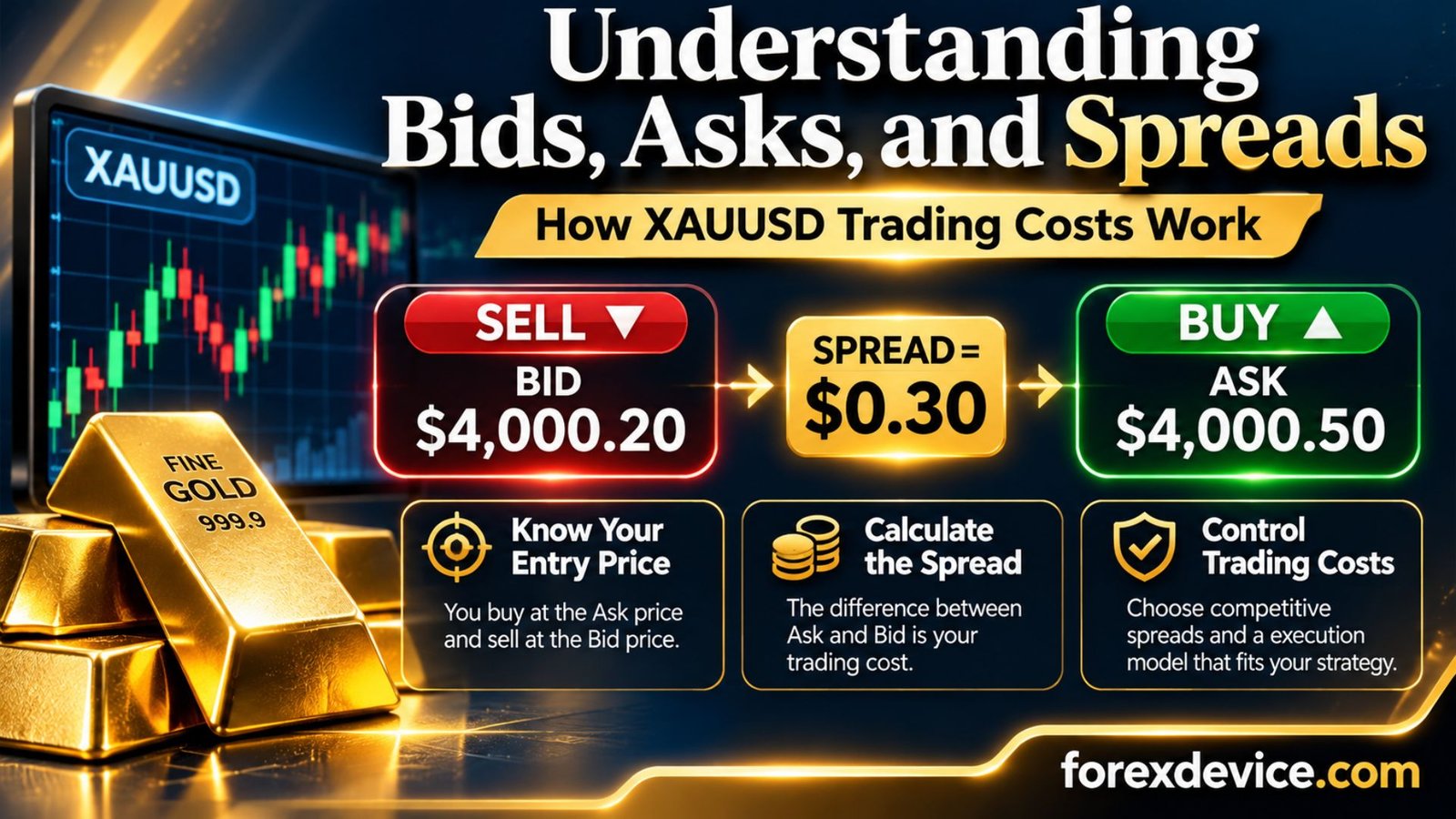
These are illustrative prices, not a live quotation. The important distinction is that a trader opening a buy position pays $4,000.50 per ounce of exposure, while a trader opening a sell position receives a price based on $4,000.20.
When the market moves, both quotations can change. The spread may remain approximately constant or widen and narrow depending on the broker’s pricing and prevailing market conditions.
Calculating the XAUUSD Spread Correctly
The spread is calculated by subtracting the bid price from the ask price:
Spread = Ask Price − Bid Price
Example: $4,000.50 − $4,000.20 = $0.30 per ounce.
This calculation is straightforward, but converting the result into points or pips requires attention to the broker’s symbol specifications.
Price difference versus platform points
Suppose a broker quotes XAUUSD with two decimal places, where the minimum displayed price increment is $0.01. A spread of $0.30 corresponds to 30 such points.
If another broker quotes gold with three decimal places, its platform point may be $0.001. The same $0.30 price difference would then correspond to 300 points.
The economic price difference is identical even though the number of platform points differs.
| Quotation Format | Illustrative Bid | Illustrative Ask | Spread in Points |
|---|---|---|---|
| Two decimal places | 4000.20 | 4000.50 | 30 points at 0.01 each |
| Three decimal places | 4000.200 | 4000.500 | 300 points at 0.001 each |
Why gold pip terminology can be confusing
Unlike major currency pairs, XAUUSD does not have a universally applied retail pip convention across every broker and trading platform. Some traders refer to $0.01 as a pip, while others use $0.10 or a different convention.
This can create serious misunderstandings when copying settings from another account or configuring an Expert Advisor.
Instead of relying on the word “pip” alone, confirm the actual price increment, contract size, tick size, and tick value in the trading platform.
When comparing spreads across brokers, converting them into US dollars per ounce or total monetary cost for a specified position provides a more consistent basis.
How Much Does the Spread Actually Cost?
The spread is not merely a number displayed beside the chart. It directly affects the price difference a trade must overcome before becoming profitable.
Consider a trader buying gold at an ask price of $4,000.50 when the bid is $4,000.20. If the trader immediately closes the position by selling at the unchanged bid, the result is a $0.30 loss per ounce of exposure, before commissions.
To calculate the monetary spread cost, multiply the spread in dollars per ounce by the number of ounces represented by the position.
Example: The Same Spread Across Different Lot Sizes
Assume a broker where one standard lot represents 100 troy ounces of gold, and the quoted spread is $0.30 per ounce.
| Position Size | Gold Exposure | Immediate Spread Cost |
|---|---|---|
| 0.01 lot | 1 ounce | $0.30 |
| 0.05 lot | 5 ounces | $1.50 |
| 0.10 lot | 10 ounces | $3.00 |
| 0.50 lot | 50 ounces | $15.00 |
| 1.00 lot | 100 ounces | $30.00 |
These amounts assume unchanged quotations, immediate closing, a USD-denominated account, and no additional costs. Broker contract sizes can differ.
Why a newly opened trade often shows a negative result
When a buy order opens at the ask, the platform generally values the immediately closable position using the bid. For a sell position, the opposite applies: it opens at the bid and is normally valued for closing against the ask.
Consequently, a position can show a small negative floating result immediately after opening, even when the underlying quotation has not moved.
Commissions, conversion costs, and other charges may affect the displayed account result separately.
The break-even price for a buy position
Suppose a buy position opens at $4,000.50. Ignoring commission and slippage, the bid must rise to $4,000.50 for the trader to close at break-even.
If the spread remains $0.30, the ask would then be $4,000.80. The market’s quoted prices have moved, but the trade has only just overcome its entry cost.
For a sell position entered at a bid of $4,000.20, the ask must fall to $4,000.20 for a break-even close, excluding additional costs.
Important: The spread is a round-trip price disadvantage when buying and immediately selling at unchanged quotations. It should not automatically be counted twice as two separate full-spread charges. Additional commissions may still apply on both sides of the trade.
How Bid and Ask Prices Affect Charts, Stops, and Pending Orders
One of the most confusing experiences for newer traders is seeing an order execute at a price that appears different from the chart line they were watching.
This often happens because the chart displays only one side of the market.
The bid-line convention in MetaTrader
Many standard MetaTrader charts display bid-based price data. The ask price may be visible in Market Watch or through an optional ask line, but it is not necessarily represented by the main candle display.
For a buy position, the closing side is normally the bid. For a sell position, the closing side is normally the ask.
That distinction affects how traders interpret stops, targets, and order activation.
| Position or Order | Relevant Quotation | Practical Meaning |
|---|---|---|
| Market buy entry | Ask | Buy at the available ask |
| Market sell entry | Bid | Sell at the available bid |
| Closing a buy | Bid | Sell to exit the long position |
| Closing a sell | Ask | Buy to exit the short position |
| Buy Stop activation | Normally ask | Ask reaches the buy-stop trigger |
| Sell Stop activation | Normally bid | Bid reaches the sell-stop trigger |
These conventions describe common OTC MetaTrader arrangements. Exact trigger and execution behavior should be confirmed with the broker, platform, order type, and applicable execution rules.
Why a sell stop-loss may trigger before the visible chart reaches it
Imagine a trader has a short position with a stop-loss at $4,010.00. The chart displays a bid of $4,009.75, but the current ask has risen to $4,010.05.
Because closing a short position requires buying, the ask quotation may activate the stop even though the bid-based chart has not visually touched $4,010.00.
This is not, by itself, evidence of incorrect execution. It may simply reflect the difference between bid and ask pricing.
Spread expansion and pending orders
Suppose a buy-stop order is placed above a breakout level. A sudden increase in the ask price can trigger the order even when the bid-based chart appears to remain below that level.
Similarly, spread changes can influence stop-loss activation on short positions.
Traders should therefore inspect both sides of the quotation when investigating unexpected order activation, particularly during news releases or thin-liquidity periods.
Why Gold Spreads Widen During Certain Market Conditions
Spreads are influenced by liquidity, volatility, competition among price providers, and the risks associated with providing executable quotations.
Gold is actively traded internationally, but liquidity is not uniform throughout the trading day.
Major economic announcements
US inflation data, employment reports, and Federal Reserve policy announcements can change expectations about interest rates and the dollar. During rapid repricing, liquidity providers may adjust quotations or reduce available liquidity.
As a result, XAUUSD spreads can widen at precisely the moment when price movement becomes most attractive to short-term traders.
A trader expecting a $2 gold movement may find that an unusually large spread consumes a significant portion of the potential reward.
Daily market transitions
Gold CFD trading hours vary by broker, and some providers have a daily maintenance or trading break. Around such transitions, market depth and available quotations may deteriorate.
Spreads may also behave differently during quieter portions of the Asian session compared with more active periods. However, there is no guaranteed spread pattern for every broker or every trading day.
Weekend reopening and unexpected events
When trading resumes after the weekend, new information may have accumulated while the market was closed. The first available quotations can differ significantly from the previous closing prices.
Wider spreads, gaps, and slippage may occur. A stop-loss cannot guarantee execution at its specified price when the market reopens beyond that level.
Illustrative Spread Expansion
Assume a normal spread of $0.25 per ounce widens to $1.50 during an unusually volatile period.
For a 10-ounce position, the immediate round-trip spread cost at unchanged quotations rises from $2.50 to $15.00.
That is a sixfold increase in the spread component of trading costs, without any change in position size.
The values above illustrate a mechanism rather than typical or guaranteed broker spreads.
Fixed Spreads, Floating Spreads, and Commission-Based Accounts
Different trading accounts may present trading costs in different ways. Comparing only the displayed spread can therefore be misleading.
Fixed-spread arrangements
A fixed-spread account aims to quote a relatively stable difference between bid and ask prices under specified conditions. However, fixed does not necessarily mean that every market condition, instrument, or trading period is covered without exceptions.
Traders should examine the broker’s terms for volatile markets, unusual events, trading interruptions, and execution restrictions.
Floating-spread arrangements
A floating spread changes as market conditions and available quotations change. It may narrow when liquidity is favorable and widen during volatility or reduced market participation.
Floating spreads can be attractive during liquid periods, but the lowest advertised spread is not necessarily representative of actual trading costs over time.
Raw-spread and commission-based accounts
Some accounts advertise relatively narrow spreads while charging a separate trading commission. Others incorporate more of the broker’s compensation into the quoted spread.
Neither model is automatically cheaper. The appropriate comparison is total trading cost for the same instrument, position size, and trading conditions.
| Illustrative Account | Spread Cost | Round-Trip Commission | Total |
|---|---|---|---|
| Account A | $8.00 | $0.00 | $8.00 |
| Account B | $2.50 | $5.00 | $7.50 |
| Account C | $4.00 | $6.00 | $10.00 |
These hypothetical costs refer to an identical position and exclude slippage, financing, and currency conversion. Actual broker charges must be checked directly.
Account B is cheapest in this example, but a different spread during the actual trading session could change the comparison.
Why Spreads Matter More to Scalpers and Breakout Traders
Trading costs matter to every strategy, but their relative importance increases when the expected profit per trade is small.
A strategy targeting a $1 movement in gold is more sensitive to a $0.40 spread than a strategy targeting a $15 movement, assuming comparable position exposure and other conditions.
Spread as a percentage of the target
Consider three hypothetical strategies with the same $0.40 spread per ounce:
| Planned Gross Price Move | Spread | Spread as % of Move |
|---|---|---|
| $1.00 | $0.40 | 40% |
| $4.00 | $0.40 | 10% |
| $10.00 | $0.40 | 4% |
The comparison is a simplified cost-to-movement illustration. Actual realized profit depends on entry and exit quotations, commissions, execution, and whether the planned movement occurs.
For high-frequency or short-duration approaches, relatively small changes in spreads can materially affect expectancy.
Spread filters in automated trading
Some Expert Advisors use a maximum-spread condition to prevent new entries when the quoted spread exceeds a configured threshold.
Such a filter can help avoid certain unfavorable entry conditions, but it cannot guarantee execution at the observed spread. Prices may change between the spread check and order execution.
Traders also need to confirm whether the EA’s spread parameter is expressed in platform points, pips, or another unit. Incorrect interpretation can make a filter much stricter or looser than intended.
For a broader introduction to gold market concepts and execution considerations, explore the ForexDevice XAUUSD Knowledge Hub.
A Practical Checklist Before Executing an XAUUSD Trade
Understanding spreads becomes most useful when it changes how traders evaluate real orders.
- Check both quotations. Look at the current bid and ask instead of relying on a single chart price.
- Calculate the actual spread. Subtract bid from ask and express the difference in dollars per ounce.
- Confirm the contract specification. Check lot size, tick size, tick value, and the platform’s point definition.
- Estimate monetary costs. Convert the spread into the cost for your intended position size, then include commissions.
- Review market conditions. Check scheduled announcements, session transitions, and unusual volatility.
- Understand order triggers. Identify whether the relevant order is activated by bid or ask and how execution may differ from the trigger price.
- Assess the strategy’s economics. Compare realistic trading costs with the expected gross opportunity and planned risk.
For systematic traders, these checks can become part of a documented pre-trade routine. Automated strategies can incorporate relevant controls, while manual traders can use a platform checklist.
It is also useful to retain execution records. Comparing quoted prices, requested prices, actual fills, and trading costs helps distinguish normal spread behavior from possible execution issues.
Frequently Asked Questions About XAUUSD Bids, Asks, and Spreads
What is the difference between bid and ask in gold trading?
The bid is normally the price at which a trader can sell, while the ask is the price at which a trader can buy. The ask is usually higher than the bid, and the difference is the spread.
Why does my gold trade start with a negative profit?
A buy position opens at the ask but is normally valued for closing at the bid. A sell position opens at the bid but is valued against the ask. This creates an immediate spread-related price disadvantage, before other trading costs.
Is a zero-spread XAUUSD account completely free?
No. An advertised zero or near-zero spread may apply only during certain conditions. Commissions, slippage, financing, and other charges may still apply.
Why does my sell stop-loss trigger when the chart has not reached it?
A short position is normally closed by buying at the ask. If the chart displays bid prices, the ask may reach the stop level before the visible bid-based candle does.
What is a good spread for XAUUSD?
There is no universal number suitable for every broker or strategy. A useful spread must be evaluated relative to contract specifications, position size, commission, volatility, execution quality, and the strategy’s expected price movement.
Do spreads always increase during major news?
No. Spreads frequently widen during uncertainty or reduced liquidity, but the extent and timing vary across brokers and market conditions. An individual news event does not guarantee a specific spread response.
Does a lower spread guarantee better trading results?
No. Lower spreads reduce one component of trading cost, but results also depend on the strategy, execution, commissions, slippage, risk management, and market conditions.
Key Lessons: Read the Quote Before Reading the Opportunity
Every XAUUSD trade involves more than predicting whether gold will rise or fall. It also involves understanding the price at which the position can be opened, the price at which it can be closed, and the costs between those two actions.
The bid and ask determine the executable sides of the market. Their difference—the spread—creates a trading cost that becomes especially important for short-duration strategies, tight stops, and frequent execution.
Spreads can change with liquidity and volatility, and they interact with order activation, floating profit and loss, broker pricing arrangements, and automated trading settings.
A trader who understands these mechanics is better equipped to interpret platform behavior, compare brokers meaningfully, and evaluate strategy performance using realistic costs.
The practical objective is not to find a market with no costs. It is to understand those costs before entering and ensure they are compatible with the trading approach being used.
Sources & Further Reading
- Investor.gov — Foreign Currency Exchange Trading for Individual Investors
Regulatory investor education explaining bid and ask quotations, spread-related costs, and the risks of leveraged OTC trading. - IG — Bid-Ask Spread: What Is It and How Does It Work?
Educational discussion of spread calculation, liquidity, volatility, and transaction-cost considerations. - CME Group — Liquidity and Immediacy
Exchange education examining bid-offer spreads, market liquidity, and the role of market makers.