
Margin Requirements, Leverage, and Stop-Outs
Margin Requirements, Leverage, and Stop-Outs
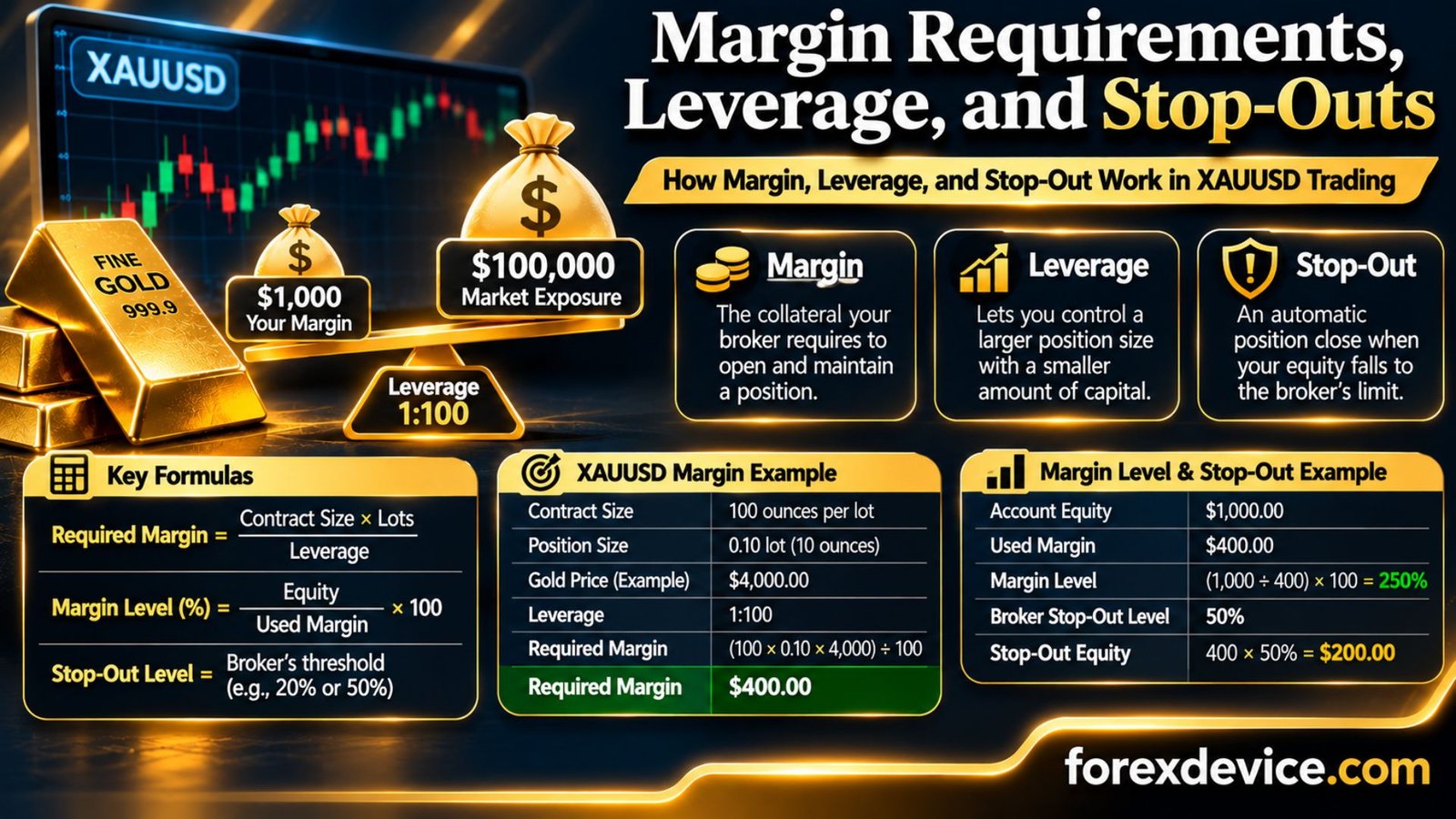
One of the most important differences between trading physical gold and trading leveraged XAUUSD contracts is the amount of capital required to control a position. A gold trader may open a position worth tens of thousands of dollars while committing only a fraction of that value as margin. This flexibility makes leveraged trading accessible, but it also creates risks that can be underestimated when traders focus only on their available account balance.
Margin, leverage, free margin, margin level, margin calls, and stop-outs are closely connected. Understanding these concepts is essential because a position can be forcibly liquidated by the broker even when the trader has not manually closed it or reached a planned stop-loss.
This guide explains how XAUUSD margin works, how leverage changes the capital required to open a position, how margin levels are calculated, and what happens when account equity falls toward a broker’s stop-out threshold. All numerical examples are hypothetical and should be checked against the actual broker’s contract specifications.
What Margin Means in Gold Trading
Margin is the amount of account equity that a broker requires to open or maintain a leveraged trading position. It is not necessarily the full purchase price of the underlying asset, and it should not be confused with the maximum possible loss.
For example, a trader might control a gold position with a notional value of $40,000 while the broker requires only $400 of initial margin under a 1:100 leverage arrangement.
The position still responds to price changes based on the full $40,000 notional exposure, not merely the $400 margin requirement.
Initial margin versus maintenance requirements
Initial margin is the collateral required to establish a position. Some trading arrangements also specify maintenance requirements or account-level thresholds that must be satisfied while positions remain open.
Retail OTC CFD brokers often present margin requirements through account leverage and instrument-specific margin rules. Exchange-traded gold futures use a different margin framework, with requirements established through exchange and clearing arrangements.
The exact definitions and calculations depend on the product, broker, jurisdiction, and account type.
Essential distinction: Margin is collateral required for exposure. It is not a stop-loss, insurance policy, or guaranteed limit on potential trading losses.
How Leverage Works in XAUUSD Trading
Leverage describes the relationship between the market exposure controlled by a position and the capital required to support it.
A leverage ratio of 1:100 means that, under a simple margin model, one unit of required margin can support 100 units of notional exposure.
Higher leverage generally reduces the initial margin needed for a given position, but it does not change the profit or loss generated by that position’s price movement.
Comparing leverage ratios
Consider a hypothetical XAUUSD position with a notional value of $40,000.
| Leverage | Illustrative Margin | Notional Exposure |
|---|---|---|
| 1:20 | $2,000 | $40,000 |
| 1:50 | $800 | $40,000 |
| 1:100 | $400 | $40,000 |
| 1:200 | $200 | $40,000 |
| 1:500 | $80 | $40,000 |
The calculations assume that the entire position is eligible for the stated leverage ratio. Real brokers may apply instrument-specific leverage, dynamic tiers, concentration limits, or different margin rates.
Notice that the market exposure remains $40,000 in every row. If the position represents 10 ounces of gold, a $10 adverse price movement still creates approximately $100 of gross loss regardless of the leverage ratio.
Why higher leverage can increase behavioral risk
Higher leverage allows traders to open larger positions with less required margin. This may encourage excessive volume because the trading platform shows that sufficient margin is available.
However, available margin does not establish whether a position is affordable or appropriately sized.
A trader who uses higher leverage to increase exposure can experience larger financial losses from the same gold price movement. The risk comes from the increased position size, not from leverage changing the value of an unchanged position.
How to Calculate Required Margin for XAUUSD
For a conventional linear gold CFD where leverage is applied directly to notional exposure, the simplified margin formula is:
Required Margin Formula
Margin = Notional Position Value ÷ Leverage
Notional position value = Gold price × Contract size × Lots.
Example: Calculating Margin for a 0.10-Lot Gold Position
Assume the following hypothetical specifications:
- Gold price: $4,000 per ounce
- Contract size: 100 ounces per lot
- Position volume: 0.10 lots
- Applicable leverage: 1:100
The position represents 10 ounces of gold.
Notional value = $4,000 × 10 = $40,000.
Required margin = $40,000 ÷ 100 = $400.
The trader needs approximately $400 of margin to support the position under these assumptions, but the position remains exposed to price movements on 10 ounces.
Actual margin may differ because of broker-specific calculation modes, account currency conversion, hedged positions, tiered leverage, or instrument-specific requirements.
For more information about how trading volume changes financial exposure, read Calculating Lot Sizes, Pips, and Profits.
Balance, Equity, Used Margin, and Free Margin
Trading platforms commonly display several account figures that describe different aspects of financial capacity. Confusing these values can lead to incorrect decisions about whether a new trade is affordable.
Balance
Balance generally represents the account’s realized financial position after completed trading activity and applicable account adjustments. Open-position profit and loss is not normally included in the balance figure.
Equity
Equity reflects account balance adjusted for floating profit and loss, together with applicable credit or other account adjustments under the platform’s rules.
Used margin
Used margin is the amount of collateral currently allocated to support open positions and relevant orders under the broker’s calculation method.
Free margin
Free margin represents the equity remaining after used margin is deducted. It is commonly used to assess whether additional exposure can be opened.
Core Account Relationships
Equity ≈ Balance + Floating P/L
Free Margin = Equity − Used Margin
Actual platform equity may also incorporate credit, commissions, and other account-specific adjustments.
A sample MetaTrader-style account dashboard
This example assumes no additional account adjustments. As open-position prices change, equity and free margin can change even when account balance remains unchanged.
Understanding Margin Level: The Account’s Risk Indicator
Margin level compares account equity with used margin. It is commonly displayed as a percentage in MetaTrader and similar platforms.
Margin Level Formula
Margin Level (%) = (Equity ÷ Used Margin) × 100
Example: $1,700 equity ÷ $400 used margin × 100 = 425%.
A higher margin level generally indicates that equity is large relative to the margin currently in use. A falling margin level may indicate deteriorating account conditions, increasing margin requirements, or both.
When no margin is in use, the margin-level percentage may be undefined or displayed differently by the platform.
Illustrative Margin-Level Risk Zones
This graphic is conceptual, not a universal percentage scale. Broker margin-call and stop-out thresholds vary, and a high margin level does not guarantee that the position is financially safe.
Why margin level can fall quickly
Suppose used margin remains at $400. If equity declines from $1,700 to $800, margin level falls from 425% to 200%.
If equity falls further to $400, margin level reaches 100%. At $200 equity, it reaches 50%.
Whether those levels trigger a warning or forced liquidation depends on the broker’s actual rules.
Margin level should therefore be interpreted alongside account equity, total open exposure, expected volatility, and potential losses—not as a standalone measure of safety.
What Is a Margin Call in Gold Trading?
A margin call is a broker-defined warning or requirement associated with insufficient account collateral. Historically, the term described a request to deposit additional funds or reduce exposure.
On modern electronic retail trading platforms, the term may refer to an account status or threshold rather than a personal telephone call or a guaranteed opportunity to add money.
Some brokers restrict new positions when a specified margin level is reached. Others may apply different warnings, account restrictions, or liquidation procedures.
Margin call versus stop-out
| Feature | Margin Call | Stop-Out |
|---|---|---|
| Primary purpose | Warn or signal insufficient margin | Reduce exposure through forced liquidation |
| Account effect | May restrict trading or require action | Open positions may be closed automatically |
| Trader action | Review exposure and broker requirements | May occur without prior manual confirmation |
| Threshold | Broker and account specific | Broker and account specific |
A margin call does not necessarily mean that all positions will be closed immediately. However, traders should not assume they will receive advance notice or have enough time to intervene before liquidation.
What Happens When a Broker Triggers a Stop-Out?
A stop-out is a broker-controlled process that closes some or all open positions when an account breaches a specified margin or equity condition.
Its purpose is generally to reduce account exposure and limit further deterioration, although it cannot guarantee that the account will avoid a negative balance.
An illustrative 50% stop-out threshold
Assume a broker uses a margin-level stop-out threshold of 50%, and the account has $400 of used margin.
The threshold is reached when equity falls to approximately $200:
Illustrative Stop-Out Calculation
$200 ÷ $400 × 100 = 50%
At this margin level, the broker’s liquidation process may begin under the assumed rules.
This is not a universal threshold. Some brokers use different margin-level percentages, equity-based rules, or product-specific liquidation arrangements.
Which position gets closed first?
The liquidation sequence depends on the broker and trading platform. Some arrangements close the largest losing position first, while others follow different procedures.
After a position is closed, used margin may decrease, potentially raising the remaining account’s margin level. Further liquidation can occur if the account still fails to meet requirements.
During fast market conditions, actual execution may occur at unfavorable prices. Multiple positions can be affected in rapid succession.
Stop-out is not a protective stop-loss. A trader-controlled stop-loss is intended to exit an individual trade at a predefined trigger. A broker stop-out is an account-level liquidation mechanism activated by margin conditions. Neither guarantees a particular execution price.
Three XAUUSD Scenarios That Explain Margin Risk
Scenario A — Moderate Exposure With Greater Account Headroom
A trader has a $5,000 account and opens 0.05 lots of XAUUSD. Assuming 100 ounces per lot, the position represents five ounces.
At $4,000 per ounce, the notional exposure is $20,000. With applicable leverage of 1:100, simplified required margin is $200.
If gold falls $20 against the position, the gross loss is approximately $100. Equity becomes about $4,900 before costs, and the margin level is approximately 2,450%, assuming margin remains $200.
This scenario demonstrates relatively substantial margin headroom, although the trade still carries market and execution risk.
Scenario B — A Larger Position on a Smaller Account
A trader has $1,000 and opens 0.20 lots, representing 20 ounces under the same contract specification.
At $4,000 per ounce, notional exposure is $80,000. At 1:100 leverage, required margin is approximately $800.
If gold moves $20 against the position, the gross loss is $400. Equity falls to approximately $600, producing a 75% margin level if used margin remains $800.
Depending on the broker’s thresholds, the account may already be under margin restrictions or approaching forced liquidation.
Scenario C — Higher Leverage Does Not Reduce Trading Loss
Consider the same 0.20-lot position, but with 1:500 leverage.
The simplified initial margin falls from $800 to $160. However, the position still represents 20 ounces.
A $20 adverse gold movement still creates approximately $400 of gross loss.
The lower margin requirement provides more margin headroom for the unchanged position, but it does not make the market exposure smaller or the trade inherently safer.
All three scenarios exclude spreads, commissions, slippage, and currency conversion. They also assume the stated leverage remains applicable and margin requirements do not change during the trade.
Practical Ways to Manage Margin and Leverage Risk
Managing margin risk begins with controlling position size rather than relying on the broker’s liquidation system.
Calculate the planned loss before opening
Determine the intended stop-loss distance and convert it into a monetary amount using the contract size and trading volume.
For a 10-ounce position, a $15 adverse movement represents approximately $150 of gross loss. The trader should assess that amount relative to account equity and personal risk capacity.
Maintain sufficient margin headroom
Free margin and margin level should be monitored alongside the combined exposure of all open positions.
A high margin level may provide more room before a broker’s liquidation threshold, but it does not replace appropriate stop-loss planning or exposure control.
Account for volatility and trading costs
Gold may experience rapid repricing around major economic releases, geopolitical developments, and thin-liquidity periods.
Wider spreads, slippage, and changes in margin requirements can affect account conditions. Traders should review broker notices concerning leverage changes and trading restrictions.
Understand correlated exposure
Several open gold positions may collectively create much greater exposure than any individual position suggests.
For example, five separate 0.10-lot XAUUSD buy positions can produce approximately the same directional exposure as one 0.50-lot buy position, assuming identical contract specifications.
Risk calculations should therefore consider aggregate exposure rather than treating every position as independent.
Margin Requirements in Automated XAUUSD Trading
Expert Advisors can open and manage positions according to programmed rules. However, automated execution does not eliminate margin requirements or the possibility of broker liquidation.
A well-designed automated trading process may include checks for available margin, existing exposure, trading permissions, and broker order restrictions before submitting new orders.
Why an EA may reject or fail to open a trade
An automated strategy may encounter insufficient margin, invalid volume, symbol restrictions, or changing broker requirements.
These conditions can prevent an order from opening even when the strategy identifies a valid technical setup.
Traders should examine platform journals and execution logs before assuming the strategy is malfunctioning.
Why lot limits matter
Automated trading settings such as minimum lot, maximum lot, and position-sizing rules influence financial exposure.
Increasing maximum volume without assessing account equity and stop-loss risk can create excessive exposure, particularly when multiple orders are permitted.
Similarly, a strategy using pending breakout orders should account for the possibility that several positions or orders may become active during volatile conditions.
Automated risk controls can reduce certain operational mistakes, but they cannot guarantee protection against gaps, slippage, connectivity failures, or extreme market conditions.
Frequently Asked Questions
What is margin in XAUUSD trading?
Margin is the collateral required by a broker to open or maintain a leveraged gold position. It is not the full position value and does not represent the maximum possible loss.
Does 1:500 leverage mean I can lose only a small amount?
No. Higher leverage reduces the margin required for a given position under a simple leverage model. Profit and loss still depend on position size and gold price movement.
What is a safe margin level for gold trading?
There is no universal safe percentage. Broker thresholds, position sizes, volatility, account equity, and potential losses all matter. A high margin level does not guarantee protection against significant losses.
What happens when margin level reaches 100%?
The result depends on the broker’s rules. Some accounts may restrict additional trading, while others apply different warning or liquidation thresholds. Reaching 100% does not universally mean automatic liquidation.
Can my account be stopped out before my stop-loss is reached?
Yes. If account equity falls sufficiently relative to margin requirements, the broker may liquidate positions before an individual trade’s planned stop-loss is triggered.
Can a stop-out cause a negative account balance?
It is possible under some trading arrangements, particularly during gaps or extreme market conditions. Negative balance protection may apply in certain jurisdictions or account types, but traders should verify their broker’s specific protections.
Does adding more money prevent stop-outs?
Adding funds can increase account equity and margin headroom, but it does not remove market risk or guarantee that liquidation will be avoided. Depositing more money into a losing position should not replace a defined risk-management plan.
Final Takeaways: Margin Is Capacity, Not Protection
Margin and leverage determine how much collateral is required to control a gold position, while position size determines how strongly price movements affect account profit and loss.
Understanding balance, equity, free margin, and margin level helps traders interpret account conditions and recognize when exposure is becoming difficult to support.
Margin calls and stop-outs are broker-controlled mechanisms, not substitutes for risk management. Their thresholds and liquidation procedures vary, and execution during volatile conditions may produce losses beyond planned levels.
The most important principle is to calculate financial risk before using available leverage. A position should be evaluated according to its potential loss, combined account exposure, and suitability for the trader’s circumstances—not simply whether the platform permits it.
For further learning, explore the ForexDevice XAUUSD Knowledge Hub for related guides on trading costs, position sizing, and market mechanics.
Sources & Further Reading
- CME Group — Margin: Know What’s Needed
Exchange education explaining margin requirements, leverage, and collateral considerations in futures markets. - MetaTrader 5 — Trading Operations
Official platform documentation describing trading operations and account-related trading mechanics. - Investor.gov — Margin
Investor education explaining the general concept of using borrowed funds or collateral for leveraged investment exposure.