
Psychology of Consistency and Discipline
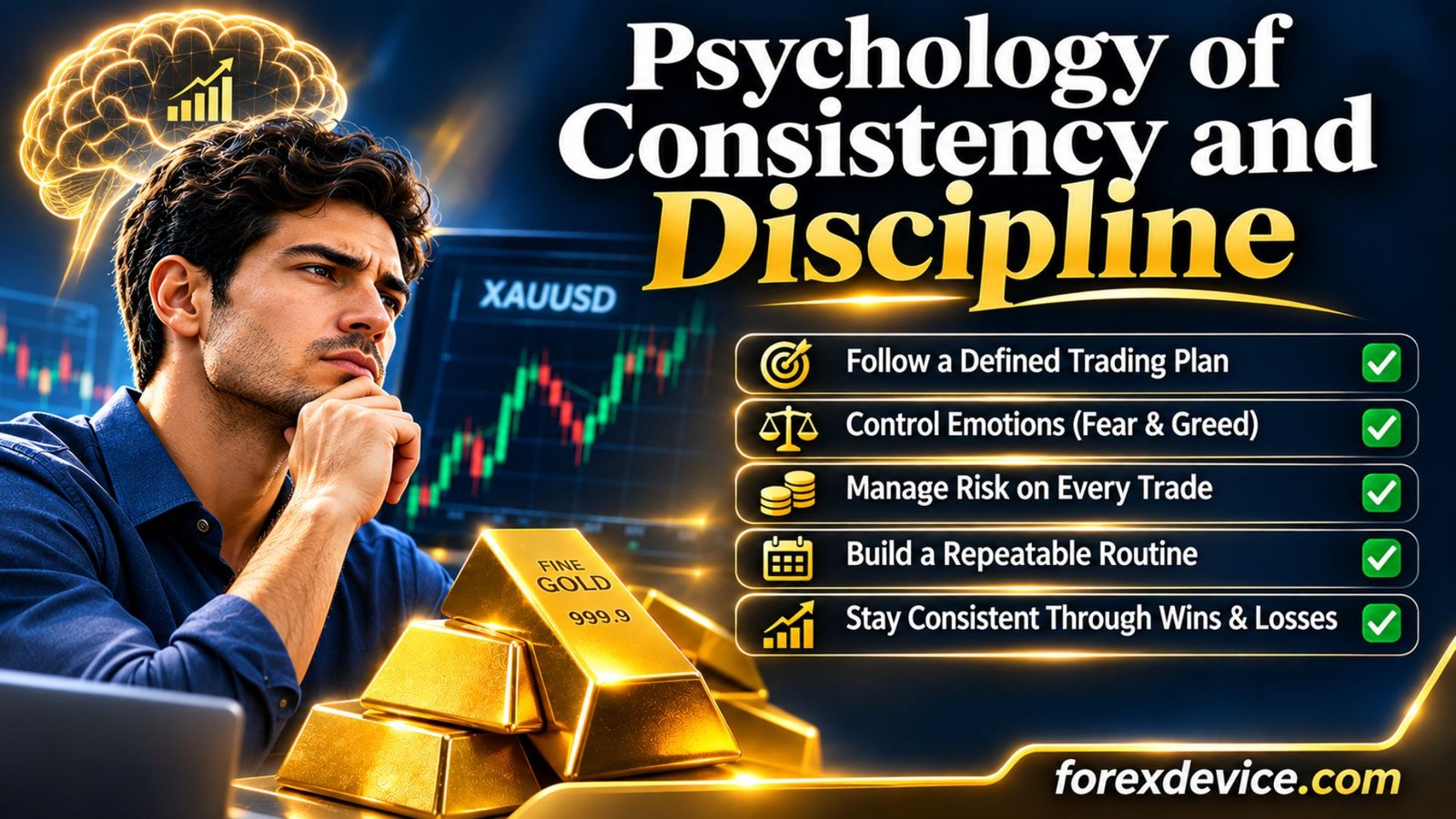
Psychology of Consistency and Discipline
Two gold traders can study the same XAUUSD chart, identify the same support and resistance levels, and even use the same trading strategy—yet produce very different results. The difference may have little to do with technical knowledge. It may come from how each trader responds to uncertainty, missed opportunities, winning streaks, and financial losses.
Trading psychology is not about eliminating emotions or remaining permanently calm. It is about developing a decision-making process that remains dependable when emotions become intense. This guide explores the psychology of consistency and discipline in gold trading, with practical methods for controlling impulsive decisions, following trading rules, and measuring genuine improvement.
What Consistency Really Means in Gold Trading
Many traders define consistency as making money every day. That definition creates an unrealistic expectation because financial markets do not provide equally favorable opportunities every session, and even a strategy with a genuine statistical advantage can experience losing periods.
A more useful definition is consistent execution of a clearly defined trading process. This means evaluating setups according to the same rules, maintaining appropriate risk limits, and recording decisions honestly regardless of whether individual trades win or lose.
Consider a trader who follows a breakout strategy on the 15-minute XAUUSD chart. On Monday, the setup produces a profit. On Tuesday, a similar valid setup reaches its stop-loss. On Wednesday, the market remains sideways and no trade qualifies.
If the trader followed the plan on all three days, the behavior was consistent even though the financial outcomes differed.
Consistency is not identical results. It is the ability to apply a repeatable decision-making process across changing market conditions, including periods when the strategy performs poorly.
This distinction matters because traders who demand daily profits may force trades during unfavorable conditions. A trader focused on process quality can recognize that avoiding a poor opportunity is sometimes the most disciplined decision of the session.
The Emotional Trading Cycle: From Confidence to Frustration
Trading involves repeated exposure to uncertain outcomes. That uncertainty can produce a recognizable sequence of emotional reactions, particularly when a trader becomes attached to an expected market direction.
| Emotional State | Typical Thought | Potential Behavior |
|---|---|---|
| Excitement | Gold is moving quickly; I must enter. | Chasing an extended candle |
| Confidence | My last trades worked; I understand this market. | Increasing exposure without justification |
| Anxiety | What if this profitable trade reverses? | Closing before the planned exit |
| Denial | Gold will eventually return to my entry. | Moving or removing the stop-loss |
| Frustration | I need to recover that loss immediately. | Revenge trading or overtrading |
These reactions are possible behavioral patterns, not fixed psychological stages that every trader experiences in the same order.
Why gold trading can intensify emotions
XAUUSD can experience rapid price changes around important economic announcements, changes in US interest-rate expectations, and shifts in market sentiment. A trader watching a leveraged position during such movement may feel pressure to make immediate decisions.
The key challenge is not that the trader feels fear or excitement. It is whether those feelings cause the trader to abandon predefined entry, exit, or risk-management rules.
A practical intervention is to recognize emotional warning signs before placing an order. These might include repeatedly refreshing account equity, feeling compelled to recover a loss, or changing position size because of recent profits.
Psychological Biases That Influence XAUUSD Decisions
Behavioral finance examines how psychological tendencies can affect financial decisions. Understanding these tendencies helps traders identify when their reasoning may be distorted.
Loss aversion and the disposition effect
Loss aversion describes the tendency to experience losses as especially painful relative to comparable gains. A related behavioral pattern, the disposition effect, involves selling profitable positions too early while retaining losing positions too long.
For example, a trader may close a gold position after a small favorable move because they fear losing the unrealized profit. When another position moves against them, they may avoid exiting because doing so would confirm the loss.
The resulting pattern can be financially damaging even when the trader identifies market direction correctly on many occasions.
Confirmation bias
Confirmation bias occurs when people favor information that supports an existing belief while discounting contradictory evidence.
A trader expecting gold to rise may focus on bullish candlestick patterns while overlooking a bearish higher-timeframe structure, strengthening dollar conditions, or an approaching resistance zone.
A useful countermeasure is to document what would invalidate the original market view before entering.
Recency bias and overconfidence
Recent results can influence expectations disproportionately. After several winning trades, a trader may assume the next setup is more likely to succeed, even when the statistical characteristics of the strategy have not changed.
After several losses, the same trader may abandon a valid process prematurely.
Fear of missing out
Fear of missing out, commonly called FOMO, can develop when gold makes a strong directional move and the trader remains outside the market.
Social media screenshots, trading-group messages, and rapidly moving price charts can amplify the impression that an opportunity must be captured immediately.
However, a missed trade does not create an obligation to enter at a worse price. The appropriate response is to wait for another setup that satisfies the strategy’s rules.
A Useful Bias-Control Exercise
Before submitting a trade, write down three things: the evidence supporting the setup, the evidence contradicting it, and the price or condition that would invalidate it.
This exercise does not eliminate bias, but it encourages decisions based on observable evidence rather than conviction alone.
Discipline Versus Motivation: Why Rules Matter More Than Enthusiasm
Motivation can encourage someone to study charts, learn technical analysis, or develop a trading strategy. But motivation changes with mood, energy, and recent performance.
Discipline is different. It involves following an established process even when the immediate emotional reward is absent.
A motivated trader may enthusiastically study the London session after a profitable morning. The same trader may lose interest in reviewing trades after a difficult week. A disciplined trader maintains a review routine regardless of the latest result.
Turn intentions into observable rules
Vague goals such as “I will be patient” or “I will control my emotions” are difficult to evaluate. Behavioral rules should specify what the trader will actually do.
| Vague Intention | Practical Trading Rule |
|---|---|
| I will avoid overtrading. | I will enter only when my documented setup criteria are satisfied. |
| I will control losses. | I will calculate planned risk before every order and respect my session loss limit. |
| I will stop chasing gold. | I will reject entries when the required stop distance exceeds my permitted risk. |
| I will learn from mistakes. | I will record every completed trade and review rule violations after the session. |
These rules become more effective when they are simple enough to apply during fast market conditions. Excessively complicated routines can create confusion and make compliance harder to assess.
Handling Losing Trades, Drawdowns, and Recovery Pressure
A losing trade is not automatically evidence of poor execution. Even well-designed strategies can lose because the market does not behave as anticipated.
The psychological difficulty begins when traders interpret a financial loss as a personal failure or believe they must recover the money immediately.
Separate planned losses from rule violations
Suppose a trader identifies a valid XAUUSD breakout, calculates position size correctly, and places a stop-loss at the planned invalidation level. The breakout fails, and the position closes at a loss.
That trade may have been executed correctly despite its negative result.
Now imagine another trader enters without confirmation, doubles the planned position size, and removes the stop when price moves against them. Even if the market later reverses and produces a profit, the execution was undisciplined.
Evaluating these situations separately prevents traders from rewarding reckless behavior simply because it occasionally works.
Understand the mathematics of drawdown
Drawdown measures the decline from a previous account-equity peak. Recovering from a drawdown requires a larger percentage gain than the percentage originally lost.
| Account Drawdown | Gain Required to Recover |
|---|---|
| 5% | 5.26% |
| 10% | 11.11% |
| 20% | 25% |
| 30% | 42.86% |
| 50% | 100% |
These figures are mathematical recovery requirements, not forecasts or achievable return targets.
The lesson is that protecting capital becomes increasingly important as losses accumulate. Attempting to recover rapidly through larger positions can deepen the drawdown.
Use a predefined response to losing streaks
A trader might establish a session loss limit, require a review after consecutive losses, or temporarily switch to simulated trading when repeated rule violations appear.
Such measures should be designed around the strategy and personal risk capacity. There is no universal number of consecutive losses that automatically makes a strategy invalid.
For a related exploration of the emotional pressure associated with open losses, see The 5 Psychological Stages of Holding a Losing Gold Position Over the Weekend.
Why Winning Streaks Can Be as Dangerous as Losing Streaks
Losses receive most of the attention in trading psychology, but profits can also distort decision-making.
After several successful gold trades, a trader may begin to believe that market conditions are easier to predict than they really are. They may increase lot size, enter weaker setups, or disregard risk limits because recent outcomes have reinforced their confidence.
This is particularly problematic when the winning streak occurred during a favorable market regime, such as a strong directional trend. The same strategy may behave differently when volatility contracts or gold enters a choppy range.
Do not confuse confidence with evidence
Confidence should come from understanding a strategy’s tested characteristics, limitations, and risk profile—not simply from the latest account balance.
A disciplined response to a winning streak includes maintaining established risk rules, recording execution quality, and checking whether market conditions have changed.
A useful principle: Do not increase exposure solely because recent trades were profitable. Any change in risk should be supported by a documented plan and evidence, not excitement.
Building a Repeatable Daily Trading Routine
Consistency becomes easier when important decisions are made before emotional pressure develops. A structured routine reduces the number of choices that must be improvised while prices are moving.
Before the trading session
- Review the broader XAUUSD structure on relevant higher timeframes.
- Mark important support, resistance, and decision zones.
- Check the economic calendar for scheduled announcements.
- Confirm account equity, existing exposure, and permitted risk.
- Identify valid setups and conditions that would justify remaining outside the market.
During the trading session
- Wait for the defined entry conditions rather than anticipating every movement.
- Calculate position size before entering.
- Use the planned exit and management rules.
- Avoid reacting to unrelated trading-group opinions.
- Stop initiating positions when predefined risk limits are reached.
After the trading session
- Record entries, exits, costs, and screenshots.
- Identify whether each trade followed the plan.
- Note emotional triggers without treating them as personal failures.
- Review repeated mistakes rather than obsessing over one result.
- Finish the session without creating unnecessary trades to change the day’s profit or loss.
A routine should be realistic for the trader’s available time and trading style. Someone trading the London session may require a different schedule from a trader monitoring New York volatility or running an automated system.
For traders who find themselves compulsively checking charts after markets close, the article What Traders Think They Will Do on the Weekend vs. What They Actually Do offers a lighter perspective on this familiar behavior.
How to Measure Trading Discipline Instead of Just Profit
Profit and loss remain essential performance measures, but they do not explain whether trading decisions were executed correctly.
A more informative review combines financial outcomes with behavioral measures.
| Metric | How to Measure It | What It Reveals |
|---|---|---|
| Rule compliance | Compliant trades divided by total trades | How consistently the plan is followed |
| Risk compliance | Trades within planned risk limits | Whether exposure remains controlled |
| Impulsive entries | Trades lacking documented setup criteria | Frequency of emotional decisions |
| Journal completion | Trades with complete records | Quality of the review process |
| Strategy expectancy | Average gain and loss per trade after costs | Whether results suggest an economic advantage |
An example of a process score
Suppose a trader completes 20 trades during a review period. Eighteen satisfy the documented entry, risk, and management rules. The process-compliance rate is 90%.
This does not establish that the strategy is profitable or that 90% compliance is sufficient. It simply gives the trader a measurable behavioral baseline.
If profitability remains poor despite strong compliance, the strategy itself may need evaluation. If results are difficult to interpret because rules are frequently broken, execution discipline may need attention first.
This distinction helps traders avoid changing technical indicators when the underlying problem is inconsistent behavior—or blaming psychology when the strategy lacks a demonstrable edge.
The Psychology of Automated Gold Trading
Automated trading changes the form of psychological pressure rather than removing it completely.
An Expert Advisor can execute programmed entry, exit, and risk-management rules without requiring the trader to manually click every order. This may reduce some impulsive execution decisions, provided the system is configured correctly.
However, the trader still makes important decisions about strategy selection, parameters, position sizing, monitoring, and when intervention is justified.
Common psychological mistakes with trading robots
- Increasing lot size after a profitable backtest without assessing drawdown risk.
- Disabling an EA immediately after a small losing sequence without evaluating expected variability.
- Changing parameters repeatedly to match recent market behavior.
- Running multiple strategies without calculating combined account exposure.
- Assuming that automated execution guarantees consistent profits.
Automation can make execution more systematic, but a poorly designed or unsuitable strategy remains risky even when every order is executed exactly as programmed.
Separate monitoring from emotional interference
A useful automation policy defines when the trader should intervene. Examples include technical failures, broker execution problems, breached risk limits, or evidence that actual behavior differs materially from documented expectations.
By contrast, changing settings merely because the last few trades lost money can introduce new risks and make performance harder to evaluate.
Automated systems require ongoing oversight, realistic testing, and awareness that historical results do not guarantee future performance.
A Practical 30-Day Trading Psychology Development Framework
Psychological improvement becomes more manageable when broad goals are divided into small, observable behaviors. The following framework is a training exercise, not a promise that trading performance will improve within 30 days.
| Period | Primary Focus | Practical Exercise |
|---|---|---|
| Days 1–7 | Self-awareness | Record emotional triggers and decisions without changing the strategy |
| Days 8–14 | Rule clarity | Define objective entry, exit, risk, and no-trade conditions |
| Days 15–21 | Execution discipline | Use a checklist before every simulated or appropriately risk-controlled trade |
| Days 22–30 | Evaluation | Review rule compliance, mistakes, and strategy outcomes separately |
Week one: observe before attempting to change
Begin by identifying when discipline breaks down. Is it after a missed breakout, a stop-loss, a profitable morning, or a major economic announcement?
Write down the circumstances and the decision that followed. The objective is to recognize patterns rather than judge yourself based on individual outcomes.
Week two: make the rules measurable
Convert general intentions into specific conditions. Define acceptable setups, risk limits, position-management rules, and situations where no trade should be placed.
Keep the rules simple enough to evaluate objectively.
Week three: practice consistent execution
Apply the checklist without changing it after every trade. A demo environment can be useful for practicing behavior without placing real capital at risk, although simulated trading does not reproduce all the psychological pressures of live trading.
Week four: review the evidence
Compare the first and final weeks. Look for changes in impulsive entries, risk violations, journal completion, and adherence to the planned process.
If the sample is too small to support conclusions about strategy performance, continue collecting observations rather than declaring success or failure prematurely.
Five Questions for Every Weekly Review
- Which trading rules did I follow consistently?
- Which situations triggered emotional decisions?
- Did I take unnecessary risks after wins or losses?
- Were my mistakes caused by execution or strategy design?
- What single behavioral improvement should I prioritize next week?
The purpose of the exercise is to establish a sustainable improvement process, not to eliminate all mistakes within an arbitrary deadline.
Frequently Asked Questions
What is trading psychology in XAUUSD?
Trading psychology refers to the emotions, beliefs, habits, and cognitive biases that influence trading decisions. In XAUUSD, it affects how traders respond to volatility, losses, profits, missed opportunities, and changing market conditions.
How can I become more disciplined in gold trading?
Start with a written trading plan, objective entry criteria, predefined risk limits, and a consistent review routine. Measure whether you follow your rules rather than evaluating discipline solely through daily profits.
Why do I keep breaking my trading rules?
Possible reasons include unclear rules, excessive financial exposure, fear of missing out, recovery pressure, or a strategy that does not fit your circumstances. Recording when violations occur can help identify the underlying triggers.
Should I stop trading after consecutive losses?
A predefined pause or review rule can help prevent emotionally driven decisions. The appropriate threshold depends on the strategy, financial circumstances, and risk plan. A losing sequence alone does not necessarily prove the strategy has failed.
Can a trading robot improve discipline?
An EA can automate predefined execution rules and reduce some manual decisions. However, the trader must still manage configuration, risk, monitoring, and interventions. Automation does not remove psychological or financial risk.
Is consistency more important than a high win rate?
Both process quality and financial outcomes matter, but they answer different questions. Consistent execution makes strategy results easier to evaluate. A high win rate alone does not guarantee profitability if average losses and trading costs exceed average gains.
How long does it take to develop trading discipline?
There is no reliable universal timeline. Discipline develops through repeated practice, realistic expectations, objective feedback, and a trading process suited to the individual. Progress should be measured through behavior over time rather than a fixed number of days.
Final Perspective: Consistency Is Built Through Decisions, Not Predictions
The most important psychological challenge in trading is not predicting every movement in gold. It is maintaining a reliable decision-making process when the market behaves differently from expectations.
A disciplined trader accepts that uncertainty cannot be eliminated. They calculate risk before entering, distinguish valid losses from execution mistakes, avoid changing rules impulsively, and review performance using meaningful evidence.
Consistency also requires flexibility at the correct level. Traders should remain faithful to established execution rules during individual trades while remaining willing to reassess a strategy when sufficient evidence shows that its assumptions or performance characteristics have changed.
The goal is not emotional perfection. It is to prevent temporary emotions from repeatedly controlling financial decisions.
Ultimately, psychological discipline cannot turn an unprofitable strategy into a profitable one. But it can help traders evaluate their methods more accurately, limit avoidable mistakes, and approach XAUUSD trading with greater structure and accountability.
Sources & Further Reading
- CME Group — Trading Psychology: Making It Real
Educational material on self-awareness, personal trading plans, motivation, risk, and consistent execution. - Investor.gov — Behavioral Patterns of U.S. Investors
Investor education discussing behavioral tendencies including the disposition effect, excessive trading, and reactions to market information. - FINRA — Social Sentiment Investing Tools: Think Twice Before Trading Based on Social Media
Regulatory investor guidance examining social sentiment, impulsive decisions, and the risks of relying on online trading information.