
XAUUSD Weekend Gaps: Why Gold Opens Higher or Lower on Monday
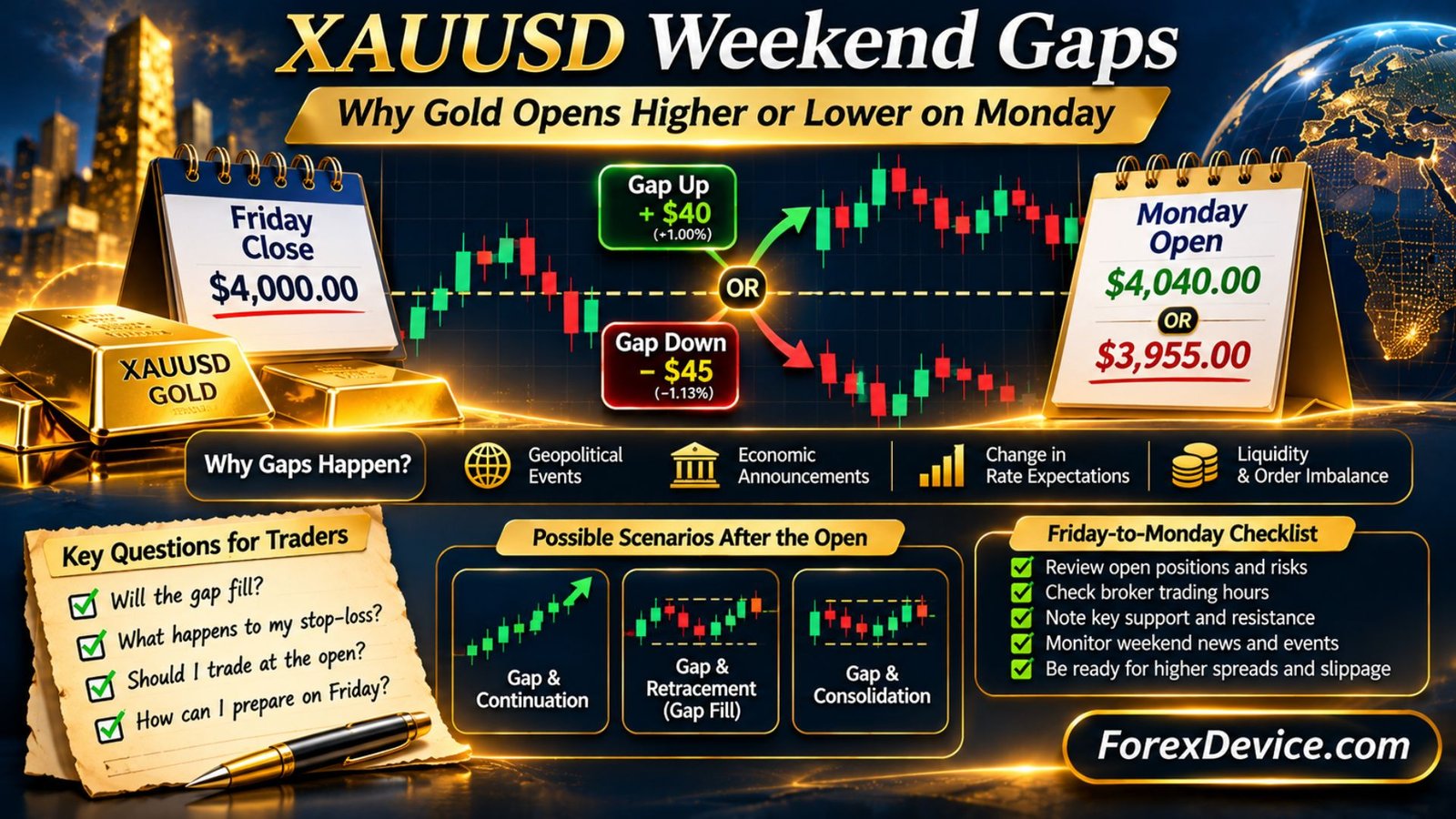
XAUUSD Weekend Gaps: Why Gold Opens Higher or Lower on Monday
Imagine this: you check your gold trading account on Friday evening. XAUUSD is trading near $4,000, your position has a stop-loss in place, and everything appears under control.
Then the weekend arrives.
On Sunday, an unexpected geopolitical development changes financial-market expectations. When your broker resumes quoting gold, the first available price is $4,035.
Gold has apparently jumped $35 without showing the normal sequence of tradable prices between Friday’s close and the new opening quotation.
What happened? Could a stop-loss execute at a different price? Will gold return to Friday’s closing level? And how should traders or Expert Advisors handle the reopening?
These are practical questions because weekend gaps can affect entries, exits, margin requirements, and automated trading behavior.
This guide explains how XAUUSD weekend gaps develop, why liquidity matters, what traders should monitor before the market closes, and how to approach the reopening with a structured plan.
All price examples in this article are hypothetical and are provided to explain trading mechanics rather than predict future gold prices.
What Is an XAUUSD Weekend Gap?
A weekend gap occurs when the first available price after the weekend differs from the last price quoted before trading paused.
On a chart, this can appear as a visible space between Friday’s final quotation and the opening quotation for the new trading week.
For example, suppose XAUUSD closes at $4,000 and reopens at $4,025.
$4,025 − $4,000 = +$25
This represents an upward opening gap of $25 per troy ounce.
If gold instead reopens at $3,975, the difference is −$25, representing a downward opening gap.
The quoted gap depends on the instrument, broker, data feed, and specific prices used in the comparison.
Does gold actually stop existing as a market during the weekend?
No. Gold remains an internationally traded asset with economic value even when particular trading venues and retail broker platforms are closed.
However, many major trading venues have defined weekly operating hours, and retail XAUUSD trading is generally unavailable during the weekend.
Information can continue to develop while those venues are closed. When trading resumes, the new quotations may reflect changes in expectations that accumulated during the closure.
Key takeaway: A weekend gap represents a difference between the last available pre-weekend quotation and the first available reopening quotation. It does not mean that a continuous sequence of executable prices existed between them.
Why Does Gold Open Higher or Lower After the Weekend?
Weekend gaps can arise because information continues to influence investor expectations even while major trading venues are closed.
When trading resumes, buyers and sellers may be willing to transact at prices different from those seen on Friday.
Geopolitical developments
Unexpected international events can change demand for perceived safe-haven assets, including gold.
However, gold does not respond to every geopolitical development in the same way. Currency movements, interest-rate expectations, and broader market positioning can influence the reaction.
Unexpected economic or policy announcements
Government announcements, central-bank communications, and other policy developments can alter market expectations outside regular trading hours.
When markets reopen, participants may adjust prices to reflect that information.
Changes in currency and interest-rate expectations
Because gold is commonly quoted in US dollars, changes in expectations about the dollar and interest rates may influence its price.
These relationships are complex and can change depending on the broader market environment.
Positioning and order imbalances
If significantly more participants want to buy than sell near Friday’s closing price, the market may reopen at a higher level.
The opposite can occur when selling interest dominates.
Importantly, a large gap does not automatically reveal the exact reason behind the price change. Traders should distinguish verified news from speculation about market behavior.
Gap Up vs. Gap Down: Two Practical Gold Trading Examples
Understanding the direction of a gap is straightforward. Understanding what happens next requires more careful analysis.
Example 1: Gold opens with a gap up
Suppose the last Friday quotation is $4,000.
When trading resumes, the first available quotation is $4,040.
Opening Gap: $40 Upward
A trader holding a long position may see a favorable price change, although the actual result depends on the position’s entry price and execution conditions.
A trader holding a short position may experience a larger-than-expected adverse movement.
Neither situation guarantees that the gap will continue in the same direction.
Example 2: Gold opens with a gap down
Suppose gold ends Friday at $4,000 and reopens at $3,955.
Opening Gap: $45 Downward
A long position may face an unfavorable reopening price, while a short position may benefit from the lower quotation.
However, the market may continue downward, stabilize, or reverse after the opening.
How to interpret the opening difference
| Opening condition | What it shows | What it does not prove |
|---|---|---|
| Gap up | Reopening price is above Friday’s close | Gold will continue rising |
| Gap down | Reopening price is below Friday’s close | Gold will continue falling |
| Small opening difference | Reopening is relatively close to Friday’s price | Monday will remain quiet |
| Large opening difference | Significant repricing occurred between quotations | The gap must close |
Gap direction describes the initial change. Subsequent price behavior is a separate question.
When Does XAUUSD Trading Reopen After the Weekend?
Gold trading hours depend on the market and instrument being traded.
For example, major US gold futures operate under published exchange schedules, while retail spot-metal and CFD products follow broker-specific trading hours.
Many retail gold brokers resume trading around the beginning of the global trading week on Sunday evening in North America, corresponding to Monday morning in parts of Asia.
But there is no single opening minute that applies to every XAUUSD product.
Why the broker’s schedule matters
A broker may have a scheduled maintenance period, a delayed opening, or different hours during holidays.
Some platforms may display an indicative quotation before the instrument becomes available for normal order execution.
For accurate preparation, traders should check the instrument specification in their own platform.
What to check in MetaTrader
In MetaTrader 4 or MetaTrader 5, review the symbol’s specification and the broker’s published trading schedule.
Also confirm the platform’s server time, as it may not match local time or UTC.
These details are particularly important when an Expert Advisor uses scheduled trading restrictions or pending orders.
Why Market Liquidity Can Be Different at the Weekly Open
Liquidity refers to the ability to execute transactions without causing a significant change in market price.
At the start of a new trading week, participation may be different from that seen during the busiest London or New York hours.
Not all liquidity providers and market participants become active at exactly the same moment.
Spread widening
The spread is the difference between the bid and ask prices.
Under less favorable liquidity conditions, the spread may widen, increasing the cost of entering or exiting a position.
For example, suppose a broker normally quotes XAUUSD with a $0.25 bid-ask difference during active conditions.
At the weekly reopening, the spread might temporarily become substantially wider. The exact amount depends on the broker and market conditions.
This is an illustration, not a prediction of any broker’s spread.
Slippage
Slippage occurs when an order executes at a price different from the requested or expected price.
When prices move quickly or available liquidity is limited, execution may occur at the next available price rather than the originally intended level.
Thin liquidity and sharp price changes
When relatively few orders are available near a particular price, incoming orders may move through available quotations quickly.
This can produce abrupt changes in displayed prices.
Practical insight: The first visible price after the weekend may not offer the same execution conditions as an ordinary weekday quotation. Review bid, ask, spread, and actual tradability before treating the reopening as a normal market environment.
Do XAUUSD Weekend Gaps Always Fill?
One of the most common claims in trading discussions is that weekend gaps must eventually fill.
That claim is incorrect.
A gap is commonly described as filled when price returns to the previous closing level or traverses the gap region, depending on the definition being used.
Some gaps close relatively quickly. Others remain open for an extended period, and some may not close within the trader’s observation window.
Why a gap might close
The initial reopening price may reflect temporary order imbalances, uncertain liquidity, or a reaction that later changes as additional participants enter the market.
Under those conditions, price may move back toward Friday’s closing level.
Why a gap might remain open
If the market has repriced in response to significant new information, participants may continue trading around the new price region.
In that case, there is no requirement for price to return to the earlier close.
Example: The gap-fill assumption
Suppose gold closes at $4,000 and reopens at $4,040.
A trader might assume that the $40 difference must close and immediately sell.
But if gold continues toward $4,080, the position could experience a substantial adverse movement.
The problem is not that gap analysis is useless. The problem is treating a possible outcome as a certainty.
Trader’s question: Instead of asking “Will this gap fill?”, ask “What evidence supports a return toward Friday’s close, and what would invalidate that scenario?”
For any gap-fill strategy, traders should define the gap consistently and evaluate historical outcomes over a meaningful sample, including trading costs and unfavorable scenarios.
What Happens to Stop-Loss Orders During a Weekend Gap?
This is one of the most important practical aspects of weekend trading risk.
A conventional stop-loss is generally an instruction that becomes executable when its trigger conditions are met. It is not necessarily a guarantee of execution at the exact stop price.
Example: A stop-loss crossed by a gap
Suppose a trader holds a long XAUUSD position with a stop-loss at $3,980.
Gold closes Friday at $4,000.
During the weekend, new information changes market expectations. When trading resumes, the first available executable price is near $3,950.
The market has reopened below the stop-loss level.
Depending on the broker’s execution rules, the stop may be triggered and executed at an available price below $3,980.
The resulting loss may therefore be greater than the amount implied by the original stop level.
What about take-profit orders?
Take-profit orders also depend on instrument rules, available prices, and execution conditions.
Traders should not assume every order type will behave identically across brokers or market conditions.
Can a position remain open during the weekend?
Many retail brokers allow positions to remain open across the weekend, but financing charges, margin requirements, and product-specific rules may apply.
Whether holding a position is appropriate depends on the strategy and the trader’s ability to tolerate a potentially unfavorable reopening.
Traders should consult the broker’s actual order-execution policy rather than relying on general assumptions.
Three Monday Opening Scenarios Every Gold Trader Should Understand
Instead of predicting a single outcome, traders can prepare for several possible reopening behaviors.
Scenario 1: Gap and continuation
Gold opens above Friday’s closing price and continues rising as trading activity develops.
This can occur when the market’s response to new information remains strong.
Traders may examine whether the broader trend supports the movement and whether a valid strategy setup exists.
Scenario 2: Gap and partial or complete retracement
Gold opens higher but later moves back toward Friday’s close.
This may reflect changing expectations or the arrival of additional market participation.
The movement should not be treated as inevitable merely because a gap exists.
Scenario 3: Gap followed by consolidation
Gold reopens at a different price but then trades within a relatively narrow range.
Participants may be reassessing the new information or waiting for additional developments.
For breakout-oriented traders, this consolidation can become an important observation if a new range develops.
| Scenario | Possible behavior | What to evaluate |
|---|---|---|
| Gap continuation | Price extends beyond the opening level | Trend, momentum, costs, and entry rules |
| Gap retracement | Price moves toward the previous close | Market structure and confirmation |
| Gap consolidation | Price establishes a new range | Range boundaries and volatility |
These scenarios are useful for preparation, not prediction. The trader’s job is to observe which conditions actually develop.
How to Analyze a Weekend Gap Using 4H, 1H, and 15M Charts
A structured multi-timeframe approach can help traders interpret the reopening without reacting impulsively to the first large price movement.
Step 1: Record Friday’s closing reference
Identify the last relevant pre-weekend quotation from the same broker and data feed used for Monday’s analysis.
Note the timestamp and whether the reference is a bid, ask, or chart price.
Step 2: Record the first tradable reopening price
Observe the first available executable quotations after trading resumes.
Calculate the opening difference using a consistent price basis.
Step 3: Review the 4H market structure
Determine whether the reopening price is near major support, resistance, or a significant previous trading range.
Consider whether the gap aligns with or conflicts with the broader market structure.
Step 4: Examine the 1H chart
Observe how the market begins to establish structure after reopening.
Does price remain near the opening level, move further away, or begin returning toward Friday’s close?
Step 5: Use 15M for closer observation
The fifteen-minute chart can help reveal shorter-term consolidation, continuation, or rejection patterns.
However, a single fifteen-minute candle does not establish that the market has stabilized.
Step 6: Compare volatility and trading costs
Check spreads, recent candle ranges, and whether order execution is functioning normally.
If the market is unusually volatile, the strategy may require different conditions or may not present a valid setup.
Step 7: Apply the trading plan
Only consider actions that meet the strategy’s predefined rules and exposure limits.
A large gap does not create an obligation to trade.
Example workflow: Gold reopens $30 above Friday’s close. The 4H chart shows nearby resistance, the 1H chart begins consolidating, and the 15M chart shows alternating candles. Rather than assuming a gap fill or immediate continuation, the trader records the conditions and waits for the strategy’s required evidence.
Weekend Gaps and Automated XAUUSD Trading Systems
Automated trading can help execute predefined rules consistently, but weekend market closures introduce special operational considerations.
An Expert Advisor cannot guarantee execution while its broker’s instrument is closed, and it cannot control the prices at which trading resumes.
Friday trading restrictions
Some automated strategies include settings that stop new entries or attempt to close positions before the weekend.
Traders should understand whether these controls depend on broker server time, local computer time, or a custom UTC offset.
They should also verify whether the system requires incoming price ticks to process scheduled actions.
Existing positions and pending orders
Understand what happens to open positions and pending orders during the weekly closure.
Some orders may remain active, expire, or be handled according to the broker’s product rules.
These details can affect the first available trading opportunity after reopening.
Spread filters
A spread filter can prevent certain new entries when the quoted spread exceeds a configured threshold.
However, such a filter does not eliminate risk from positions already open or guarantee favorable execution of protective orders.
Reopening behavior
Traders should verify how an automated strategy handles missing quotes, rejected orders, changing spreads, and rapid price movements.
Historical testing may not reproduce every live reopening condition, particularly when the data lacks realistic bid-ask spreads or execution behavior.
Questions to ask before enabling weekend exposure
- Can the system leave positions open over the weekend?
- Does it stop placing new orders before Friday’s close?
- How does it handle pending orders when trading resumes?
- Are session restrictions based on the correct time zone?
- What happens when spreads widen?
- How does the strategy respond to rejected or delayed orders?
- Are margin and exposure limits appropriate for gap scenarios?
Automation can enforce programmed decisions, but it cannot remove the underlying uncertainty of market reopening.
The Friday-to-Monday XAUUSD Trading Checklist
Weekend preparation becomes easier when traders use a consistent process rather than making last-minute decisions.
Friday: Before the market closes
- Review all open gold positions and pending orders.
- Confirm the broker’s weekly closing time.
- Check account equity, margin, and exposure.
- Review whether the strategy permits weekend positions.
- Understand how protective orders may execute after a gap.
- Record Friday’s important support and resistance levels.
- Verify any automated Friday closing restrictions.
Weekend: Review new information
- Monitor major verified economic and geopolitical developments.
- Avoid assuming that a headline guarantees a specific gold-price reaction.
- Prepare possible reopening scenarios without committing to one.
- Check for broker announcements or schedule changes.
Monday: When XAUUSD trading resumes
- Confirm the instrument is actually tradable.
- Observe the opening bid-ask spread.
- Measure any gap using consistent quotations.
- Review 4H and 1H market structure.
- Observe 15M price action as the session develops.
- Check pending orders and existing positions.
- Apply the strategy’s entry and risk rules.
- Record the outcome for future review.
The checklist is designed to make the reopening more systematic. It does not require traders to enter a position simply because the market has opened.
Seven Common Weekend Gap Mistakes
1. Assuming every gap must close
Gap filling is a possible market behavior, not a universal rule.
2. Entering immediately after the first quote
Initial spreads and execution conditions may differ from those seen during more active sessions.
3. Assuming a stop-loss guarantees its exact price
Conventional stop orders can execute at a different available price when markets gap.
4. Ignoring broker-specific trading hours
Different instruments and brokers may resume trading at different times.
5. Overreacting to unverified weekend news
Market narratives can be incomplete or misleading. Use reliable information and observe actual price behavior.
6. Forgetting pending orders
Orders left active before the weekend may have consequences when trading resumes, depending on the broker’s rules.
7. Confusing a large gap with a complete trading setup
A gap provides information about repricing. It does not independently establish an entry, exit, or profit target.
Frequently Asked Questions About XAUUSD Weekend Gaps
Why does gold open with a gap on Monday?
Gold can reopen at a different price because economic, geopolitical, or financial-market developments change expectations while major trading venues are closed.
What is a weekend gap in XAUUSD?
It is the difference between the last available quotation before the weekly trading closure and the first relevant quotation when trading resumes.
Do gold weekend gaps always fill?
No. Some gaps close quickly, while others remain open for an extended period. There is no guarantee that gold will return to Friday’s closing price.
Can my XAUUSD stop-loss be skipped during a weekend gap?
A conventional stop-loss may execute at the next available price after its trigger conditions are met, which can differ from the requested stop level. The exact handling depends on the broker and order type.
What time does XAUUSD open on Monday?
The reopening time depends on the broker, instrument, time zone, and holiday schedule. Many retail products resume around Sunday evening in North America, corresponding to Monday in Asian time zones.
Is a gap up bullish for gold?
A gap up shows that gold reopened above the previous closing reference. It does not guarantee further upward movement.
Should I buy gold after a weekend gap down?
A gap down alone does not establish a buying opportunity. Traders should evaluate broader market structure, the reason for repricing, execution conditions, and their predefined strategy rules.
Why are spreads sometimes wider when gold reopens?
Liquidity and market participation can be different at the weekly opening. Available quotations may be less competitive, resulting in wider bid-ask spreads.
Can an Expert Advisor avoid weekend gaps?
An Expert Advisor may be programmed to restrict entries or attempt to close positions before the weekend, but it cannot eliminate all gap risk or guarantee execution at a particular price.
Can I trade XAUUSD during the weekend?
Most conventional retail XAUUSD products are unavailable for normal trading during the weekend. Exact availability depends on the broker and product.
Final Takeaways: Prepare for the Gap, Not a Prediction
Weekend gaps are a normal consequence of markets reopening after a period when many trading venues were closed.
They can reflect new information, changing expectations, and differences in available liquidity.
For XAUUSD traders, the most useful approach is to understand the mechanics of the reopening rather than assume that every gap must fill or continue.
Before Friday’s close, review exposure, pending orders, broker trading hours, and automated trading restrictions.
When trading resumes, observe the opening spread, identify important price levels, and evaluate the market using a consistent analytical framework.
Trader’s takeaway: A weekend gap tells you where gold has reopened—not where it must go next. Good preparation combines market structure, realistic execution expectations, and disciplined risk management.
For ongoing market context, explore ForexDevice Daily XAUUSD Research and the XAUUSD Knowledge Hub.
Sources and Further Reading
- CME Group — Gold Futures: Gold futures contract information and exchange trading schedules.
- Investopedia — Gap: General explanation of price gaps and chart behavior.
- London Bullion Market Association: Background on the international bullion market.