
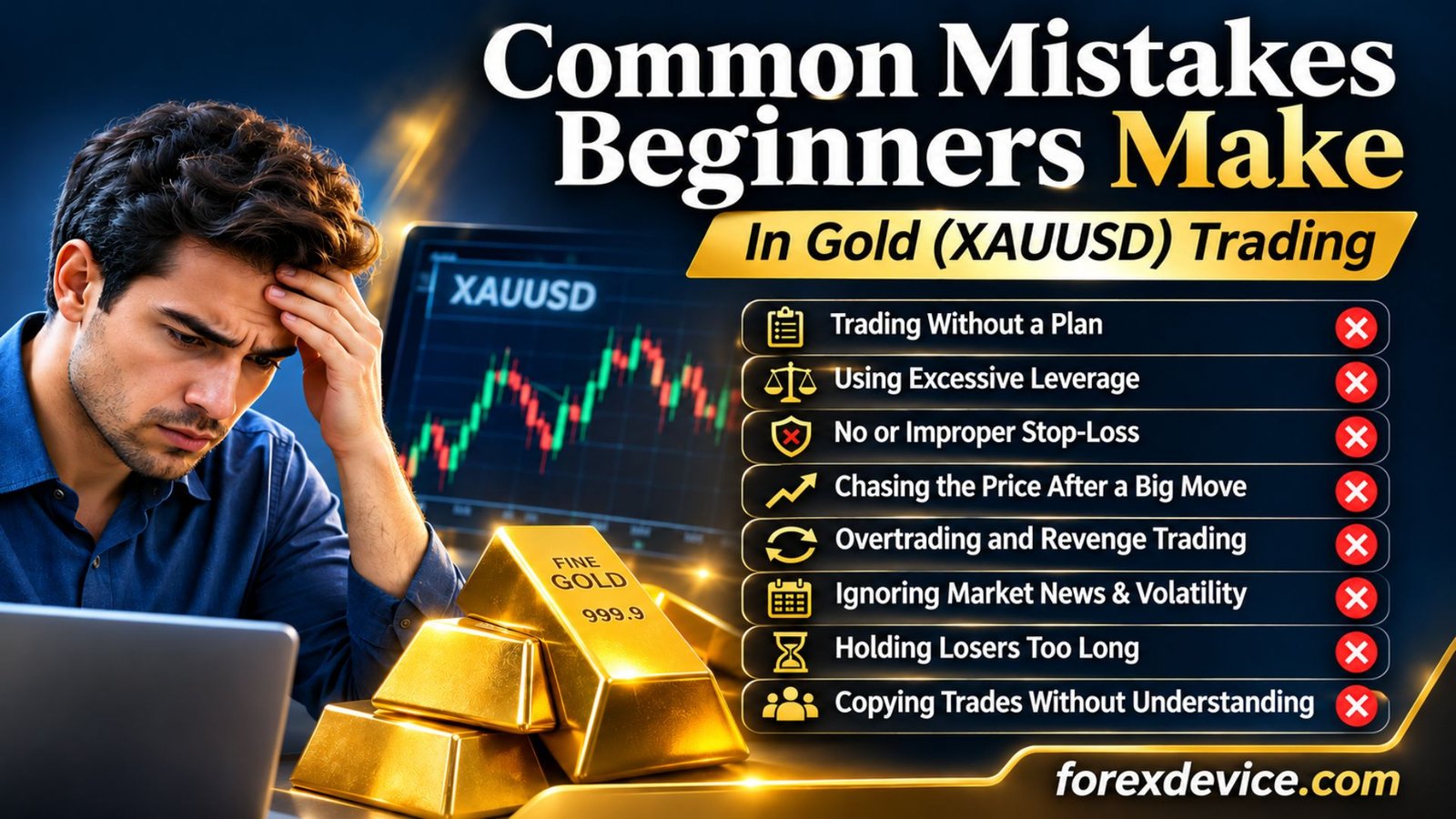
Common Mistakes Beginners Make
Common Mistakes Beginners Make
Gold trading can look deceptively simple. A chart moves upward, a trader buys, and the expectation is that the price will continue rising. Yet trading XAUUSD consistently requires far more than identifying whether the next candle might be bullish or bearish. It requires understanding risk, market conditions, execution costs, and the decisions that can turn an ordinary losing trade into a serious financial setback.
Many beginner trading mistakes are avoidable. They arise not because traders cannot read charts, but because they trade without a defined process, underestimate leverage, chase fast-moving prices, or allow emotions to override their original plan. This guide examines the most consequential mistakes new gold traders make, explains why they happen, and provides practical ways to build better trading habits.
Why Beginners Struggle With Gold
XAUUSD represents the price of gold quoted in US dollars. Depending on the trading platform, traders may access gold through contracts for difference (CFDs), futures, or other instruments. These products can have different contract sizes, margin requirements, trading costs, and regulatory protections.
Gold attracts short-term traders because it can move substantially during active market periods. However, that same movement makes poor position sizing, delayed exits, and impulsive entries particularly dangerous.
A beginner might correctly anticipate a bullish gold session but still lose money by buying too late, using excessive leverage, or placing a stop-loss at an unsuitable level. Being right about the general direction is not the same as executing a sound trade.
The central lesson: A trading decision should be evaluated by its reasoning, risk, and execution—not solely by whether the position finishes in profit.
A disciplined trader can experience a planned loss while following a sensible process. An undisciplined trader can make money on a reckless position and mistakenly believe the approach is reliable. Confusing these outcomes is one of the earliest obstacles to meaningful improvement.
Risk Management Mistakes That Damage Trading Accounts
Using excessive leverage
Leverage allows traders to control a position larger than the money committed as margin. It increases market exposure, but it does not make a trading idea more accurate. Both potential profits and losses increase with the size of the position.
For example, imagine a trader with a $2,000 account opening a gold position worth $20,000. A 1% adverse movement in the position’s value would represent approximately $200 before trading costs—equivalent to 10% of the account. The example is simplified, but it demonstrates why available margin should never be confused with affordable risk.
A broker permitting a large position does not mean that position is appropriate for the trader’s capital or financial circumstances.
Trading without a predefined stop-loss
A stop-loss is an order intended to close a position when the market reaches a specified adverse price. It helps establish a planned exit, although gaps, slippage, and fast markets can produce execution at a different price.
Beginners sometimes remove their stop-loss because they expect gold to reverse. Others repeatedly move the stop farther away to avoid realizing a loss. Both behaviors can transform a controlled trade into an uncontrolled exposure.
A more structured approach is to identify the price level that invalidates the trading idea before entering. If the required stop distance creates too much financial risk, reduce position size or skip the setup.
Choosing lot size without calculating risk
Lot size determines the quantity traded. On many XAUUSD CFD accounts, one standard lot represents 100 troy ounces, but specifications vary by broker and instrument. Traders must confirm their platform’s actual contract size and tick value.
Illustrative XAUUSD Risk Calculation
Assume a $5,000 account, a planned risk of 0.5% ($25), and a stop distance of $5 per ounce.
If the broker’s contract specification is 100 ounces per lot, a 0.01-lot position represents one ounce. A $5 adverse move would therefore produce approximately $5 of loss before costs.
Under those assumptions, 0.05 lots would expose approximately $25 to the planned price movement. Actual losses may be higher because of slippage, commissions, and execution conditions.
This is an arithmetic example, not a recommended lot size. A trader should calculate risk using the actual account currency, contract specifications, stop distance, and total existing exposure.
Increasing size after losses
Doubling position size to recover a previous loss is especially dangerous when the next trade is not independently justified. A sequence of losses can rapidly increase exposure precisely when the trader is under the greatest emotional pressure.
Risk should be determined by the trading plan and available capital, not by the amount of money the trader wants to recover.
Poor Entries and Market Timing
Chasing a candle after the move has happened
Gold sometimes produces a strong directional candle that attracts attention across trading platforms and social media. Beginners may enter immediately because they fear missing further movement.
The difficulty is that the distance to a sensible stop-loss may already be large, while the distance to nearby resistance or support may be small. The trade can have an unfavorable reward-to-risk relationship even if the broader direction is correct.
Instead of chasing, identify the next logical setup: a pullback, a retest, or a fresh breakout with acceptable risk. If no suitable entry appears, remaining outside the market is a valid decision.
Trading every breakout without confirmation
A breakout occurs when price moves beyond an identified level or range. Not every breakout produces a sustained trend. Gold can briefly cross a resistance level, attract buying, and then fall back into the previous range.
Consider a hypothetical resistance level at $4,000. Price rises to $4,006, then returns below $4,000. A trader who buys only because the level was crossed may enter at a vulnerable point.
Breakout traders can evaluate candle closes, market structure, volatility, available liquidity, and the position of nearby higher-timeframe levels. None of these filters eliminates false breakouts, but they provide a more coherent decision process.
Using the wrong timeframe for the decision
A five-minute chart may show a bullish move while the four-hour chart remains in a broader bearish structure. These observations are not necessarily contradictory: they describe different market horizons.
Beginners often change timeframes repeatedly until they find a chart that supports the trade they already want to take.
A Practical Multi-Timeframe Example
- 4H: Identify the broader market structure and major support or resistance.
- 1H: Examine the current trading range, momentum, and intermediate structure.
- 15M: Look for an entry setup, invalidation level, and manageable stop distance.
The purpose is to make the timeframes serve different roles, rather than requiring every chart to show an identical direction.
The best timeframe depends on the strategy, trading horizon, and testing evidence. Shorter charts do not automatically provide more accurate signals.
Emotional Trading, Revenge Trading, and Overtrading
Revenge trading after a loss
Revenge trading happens when a trader enters another position primarily to recover money lost on an earlier trade. The decision is driven by frustration rather than a fresh market opportunity.
Imagine losing $60 on a planned gold trade. Instead of reviewing the setup, the trader immediately opens a larger position in the opposite direction. The market moves against that position too. The original manageable loss has now become a much larger problem.
A practical safeguard is to establish a maximum daily loss, a maximum number of trades, and a rule requiring a short review after an emotionally difficult exit. These limits should be established before trading begins.
Overtrading when the market is unclear
Overtrading means taking more positions than the strategy reasonably supports. It may involve entering during sideways conditions, reacting to every small price movement, or opening several correlated positions without considering their combined risk.
More trades also mean more opportunities to incur spreads, commissions, and execution costs. Activity should not be mistaken for productivity.
Closing winners early and holding losers too long
Fear can encourage traders to close profitable positions before their planned exit, while hope encourages them to retain losing trades beyond their invalidation level.
This behavior can create an unfavorable distribution of results: relatively small winning trades and disproportionately large losses.
One way to address the problem is to define exit rules in advance. A trader may use fixed targets, trailing stops, structural exits, or another tested method. The important point is to avoid changing the rules simply because an open position feels uncomfortable.
Useful question: If you had no open position right now, would the current chart and your trading rules justify entering this same trade?
Ignoring Market Structure, Volatility, and Economic News
Treating support and resistance as guaranteed turning points
Support and resistance are areas where price has previously shown meaningful reactions. They are useful reference points, but they are not physical barriers that must hold.
A beginner may repeatedly buy near support without considering whether the market is forming lower highs, whether selling pressure is increasing, or whether a major announcement is approaching.
Levels are better treated as decision areas. Traders should consider what price behavior would support the setup and what behavior would invalidate it.
Ignoring major economic announcements
Gold can respond sharply to changes in expectations about US interest rates, inflation, economic growth, and the dollar. Important releases such as US consumer inflation data, employment reports, and Federal Reserve policy announcements can contribute to rapid repricing.
During volatile announcements, spreads may widen, liquidity may change, and stop orders may experience slippage. A technically attractive setup can therefore carry execution risks that are not obvious from the chart alone.
Beginners should know when relevant events are scheduled and decide in advance whether their strategy permits trading around them. Avoiding an event may be sensible for some approaches; others require specific, tested news-trading rules.
Ignoring the cost of entering and exiting
A trading strategy is not evaluated properly if it ignores spreads, commissions, swaps, and slippage.
For a short-term strategy with a small average target, these costs can represent a substantial share of the expected gross profit. A backtest that assumes unusually favorable execution may create an inaccurate impression of live performance.
Always examine results after realistic trading costs, especially when comparing brokers, account types, or automated strategies.
Execution and Automated Trading Mistakes
Assuming a trading robot eliminates risk
Expert Advisors (EAs) can automate predefined trading rules, including entries, exits, position management, and certain risk controls. Automation can reduce the need for continuous manual execution, but it does not eliminate market uncertainty.
An automated strategy may still experience unfavorable market conditions, technical interruptions, slippage, parameter errors, or losses during periods that differ from its testing environment.
Beginners sometimes install an EA, choose a large lot size, and assume that automatic execution means automatic profitability. In reality, automated systems require careful configuration and ongoing supervision.
Trusting a profitable backtest without further evaluation
A backtest applies trading rules to historical market data. It can help reveal how a strategy behaved under particular assumptions, but it cannot establish what future results will be.
Common weaknesses include overfitting parameters to historical prices, insufficient testing periods, unrealistic spreads, and ignoring execution differences between historical simulations and live markets.
Forward testing on a demo account, evaluating drawdowns, and comparing performance across different market environments can provide additional evidence. Even then, live results may differ substantially.
Failing to understand broker and platform settings
Before using manual or automated XAUUSD strategies, traders should verify symbol specifications, lot increments, stop-level restrictions, account leverage, trading permissions, and market hours.
An EA may fail to open an order because of insufficient margin, invalid order parameters, trading permissions, or broker-specific restrictions. The absence of a trade does not automatically indicate that the strategy is malfunctioning.
Platform logs and trading journals are valuable diagnostic tools. They help distinguish a genuine execution problem from a strategy that simply has not identified a valid entry.
Failure to Review Trades and Improve the Process
Not maintaining a trading journal
Without written records, traders often remember unusually large wins and losses while overlooking the repeated decisions that shape their overall results.
A trading journal should record more than entry and exit prices. It should explain the setup, planned risk, market context, execution conditions, and whether the trader followed the rules.
| Journal Field | What to Record | Why It Matters |
|---|---|---|
| Market context | Trend, range, volatility, news | Identifies favorable and difficult conditions |
| Trade setup | Entry reason and timeframe | Tests consistency of decisions |
| Risk | Lot size, stop, planned loss | Reveals exposure mistakes |
| Execution | Spread, slippage, actual fills | Shows real trading costs |
| Review | Outcome and rule compliance | Separates process quality from profit |
Changing strategies after a few losses
A small losing sequence does not necessarily prove that a strategy has failed. Similarly, a short winning sequence does not establish a reliable edge.
Beginners frequently abandon one indicator, adopt another, and change their settings before gathering enough comparable observations to understand either approach.
Improvement requires a consistent evaluation process. Review a meaningful sample of trades, compare actual execution with planned rules, and examine performance under different market conditions. The necessary sample size depends on the strategy and the question being tested.
Confusing win rate with profitability
A high win rate can be misleading when average losses are much larger than average gains.
For example, a hypothetical strategy winning 70 out of 100 trades, earning $20 per winner and losing $60 per loser, would produce $1,400 in gross gains against $1,800 in gross losses. The result is a $400 gross loss before costs despite winning 70% of the time.
Traders should examine average wins, average losses, drawdowns, costs, and expectancy—not only the percentage of profitable trades.
A Practical Framework for Avoiding Beginner Trading Mistakes
Knowing what not to do is useful, but beginners also need a repeatable process that can be followed during a real trading session.
| Stage | Questions to Ask | Required Action |
|---|---|---|
| Before the session | What is the market structure? Are major news events scheduled? | Define conditions and no-trade situations |
| Before entry | Is this a valid setup? Where is the invalidation level? | Calculate exposure and planned loss |
| During the trade | Has the original setup changed? | Follow predefined management rules |
| After the trade | Was the execution consistent with the plan? | Record results and mistakes |
| End of session | Were risk limits respected? | Review patterns without emotional adjustments |
A simple pre-trade checklist
- Confirm the relevant higher-timeframe trend or range.
- Identify meaningful support, resistance, and invalidation levels.
- Check upcoming economic events and current spreads.
- Calculate the potential loss using actual contract specifications.
- Verify that combined open-position risk remains acceptable.
- Determine the exit plan before submitting the order.
- Reject trades that fail the rules, even when price is moving quickly.
The objective is not to create a complicated routine. It is to remove preventable uncertainty from decisions that are already exposed to unpredictable market outcomes.
Traders developing a structured process can also explore the ForexDevice XAUUSD Knowledge Hub for related educational topics on market structure, trading plans, and risk management.
Frequently Asked Questions
What is the biggest mistake beginner gold traders make?
One of the most damaging mistakes is taking more financial risk than the account can reasonably tolerate. Excessive position size, uncontrolled leverage, and poorly managed exits can cause substantial losses even when some trading ideas are correct.
How many XAUUSD trades should a beginner take per day?
There is no universally correct number. Trade frequency should follow the strategy’s valid setups, market conditions, and risk limits. A session with no suitable opportunity does not require a trade.
Can beginners trade gold with a small account?
Account size alone does not determine suitability. Contract size, minimum trade volume, stop distance, leverage, costs, and personal financial circumstances all matter. Some accounts may be too small to implement a particular strategy with acceptable risk.
Does using a stop-loss guarantee a fixed maximum loss?
No. A conventional stop-loss becomes an order when triggered, and execution can differ from the intended price during gaps, volatility, or poor liquidity. Traders should account for this possibility when assessing risk.
Are automated gold trading robots suitable for beginners?
Automation may help execute predefined rules consistently, but beginners still need to understand the strategy, settings, broker specifications, drawdown risk, and monitoring requirements. No EA can guarantee profitable outcomes.
How can beginners tell whether their trading is improving?
Track rule compliance, position sizing, execution costs, average gains and losses, drawdowns, and decision quality over a meaningful sample. Consistent adherence to a documented process is more informative than a few isolated winning trades.
Final Takeaways: Build Better Habits Before Seeking Bigger Returns
The most expensive beginner trading mistakes often begin with small decisions: increasing lot size without calculation, entering after an impulsive price movement, ignoring a scheduled announcement, or refusing to accept a planned loss.
These behaviors become especially consequential in XAUUSD because gold can move quickly and leveraged exposure can magnify the financial impact of relatively small price changes.
A more sustainable learning process emphasizes risk limits, defined setups, realistic execution assumptions, careful recordkeeping, and continuous evaluation. It also recognizes that not every market condition offers an attractive opportunity.
Trading skill is not measured by the ability to predict every gold price movement. It is reflected in the quality of decisions made when outcomes remain uncertain. Avoiding preventable mistakes does not guarantee profitability, but it creates a stronger foundation for evaluating whether a trading approach is genuinely viable.
Sources & Further Reading
- CME Group — Position and Risk Management
Educational guidance on position sizing, stop orders, margin, and managing market exposure. - CFTC — Eight Things You Should Know Before Trading Forex
Regulatory guidance on leveraged OTC trading, broker risks, costs, and investor protection. - Investor.gov — Thinking of Day Trading? Know the Risks
Investor education discussing the financial and behavioral risks associated with active trading.